Contradictions

Lately, I have been wondering about the contradictions in our thoughts and actions:

  • We want to be slim but we eat too much
  • We want to be smart but we miss the class, or don’t read the books
  • We want happy relationships but we sabotage them with our actions
  • We have dreams but we don’t set goals
  • We want to achieve our goals but we don’t plan
  • We plan but don’t take the action
  • We worry about retirement but we don’t save
  • We want to finish the project but we don’t stay focused
  • We want to wake up early but we don’t go to bed early

The list goes on. Are human beings lazy, indisciplined, indecisive and stupid by nature? Do our genes not have the willpower to fight temptations, to persevere, to do the right thing?

What do you think?

6 Email Mistakes to Avoid

I hesitated about this post because it’s not related to enhancing life. But it will surely enhance your communications over emails. I don’t know about you but I get really peeved about a few things people do when using emails. Here are some established email etiquette to consider:

  1. Subject line. Some people try to convey the entire message in the subject line. And some people never bother to change/update the subject when the topic of the email changes. The subject line should only be used for the subject.
  2. Group emails. If sending an email to a group of people who don’t know each other, put everyone under ‘bcc’ instead of ‘to’ or ‘cc’. Otherwise you expose everyone’s email addresses without their permission.
  3. Reply. Only hit ‘reply all’ if you want all the 100 people on the email to see your reply. Otherwise, hit ‘reply’. This is particularly relevant when sending an acknowledgment to the sender.
  4. Punctuation. have you seen those emails where the writer doesn’t use any punctuation marks those emails are not only difficult to read but also very unprofessional punctuation marks are for a reason and they should be used even in informal emails. SIMILARLY, AN ENTIRE EMAIL IN UPPER CASE IS EQUIVALENT OF YELLING AT SOMEONE. and full emails in lower case are Continue reading

7 Tips for an Organized Desk

0909 cluttered desk

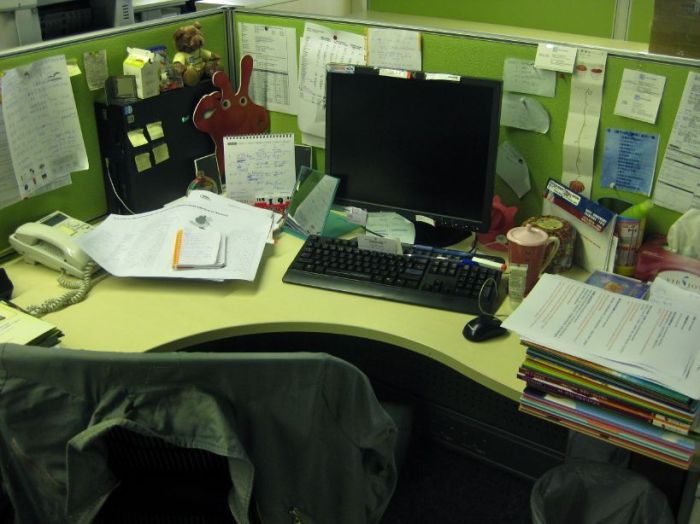
Do you have a desk full of papers you are working on, and papers you are not working on, and a few books and magazines? And dozens of pens and cups and post-its and cables? Do you think it’s a sign of creativity or imagination? The truth is, you are either too lazy to clean it up or you don’t know how. A clean desk saves you time looking for stuff; it helps you prioritize, and focus better on the tasks at hand. Here are few tips for a clean desk:

  1. Don’t collect. Don’t take those cheap gift items like pens, note pads, post-its, magazines just because they are free. Or anything else that will likely end up as trash on your desk. Throw away or give away all those pens and pencils that you don’t use. Couple of family photos or frames are OK, but more than that are a distraction. You can put them in Flickr and watch a slideshow whenever you like.
  2. Learn to deal with paper. Don’t print or copy unless necessary. For me, there are only three places for papers: trash it (or shred it or recycle it), file it away or keep in one of your ‘work-in-progress’ folders. Have a bin, shredder and recycle tray handy so you’ll never be guilty of throwing what can be recycled or afraid to trash confidential stuff.
  3. Organize in clear folders. Create clear folders with labels for all the ongoing projects. These are your ‘work-in-progress’ folders. You could also have another clear folder called ‘action’ or ‘process’ or ‘today’. This has all those 2-minute papers that you can read and trash, or forms to fill, or things to sign and pass on. Deal with this folder only once a day.
  4. The 4 D’s of time management also apply to papers. Drop it (trash it), Delay it (work-in-progress folder or the action folder), Delegate it (pass it on) or Do it (do it now, or file it away). Continue reading

Smaller the Better!

0911 kittens

From  Minimalist.com, one of my favorite blogs:

Less can come in many forms. You can have fewer things, you can do fewer things, you can use fewer things, you can focus on fewer things. But less isn’t just fewer: it can also be smaller.

Small is often downplayed in this world of “bigger means better”. But small is beautiful, and often better.

  • Smaller banks aren’t “too big to fail”, requiring bailouts when they’re mismanaged, and yet they make very important community loans.
  • Smaller teams are more nimble, can adapt to changing environments faster, don’t require as much management or communication overhead, can work cheaply and from anywhere.
  • Smaller cars use less gas, are more maneuverable, cause fewer deaths, use fewer resources.
  • Smaller homes require less heating, less cleaning, less maintenance, force you to simplify, are cozier.
  • Smaller programs use fewer computer resources, take up less computer power and thus help the environment, work faster, get the job done with a minimum of fuss.
  • Smaller suitcases (such as a small backpack) are easier to carry around, fit easier in overhead compartments, don’t require you to check luggage and worry about luggage not getting to the right destination, are easier to pack and unpack.
  • Smaller websites (in terms of file sizes) are easier to load, faster, more responsive.
  • Smaller companies are also more responsive, less expensive, hungrier, more focused.
  • Haikus pack a lot of punch into three tiny lines.
  • Smaller posts don’t take as much time to write or read, which is good for a lazy blogger. And a busy reader.

Small is beautiful. Aim for smaller when it makes sense, and enjoy the wonder that ensues.

[Photo of Mashu’s kittens]

Subscribe to get latest posts in email. Follow the latest links in Twitter. Forward this link to friends.

Clutter is Procrastination

0909 declutter

An excellent post by Leo in Mnmlist.com – one of my favorite blogs:

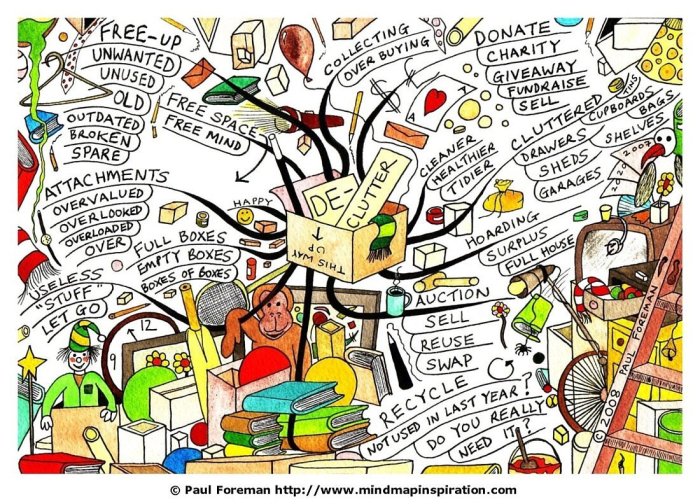
When our houses or offices get piled with clutter, much of the reason is procrastination.

We all procrastinate — let’s just get that out in the open. There’s not a one of us who doesn’t, to some degree. But while our tasks and projects can pile up, giving us some anxiety, the clutter is a visual sign of that procrastination, and carries with it just as much anxiety.

When we put down an object, a piece of paper, an article of clothing, a stack of mail … and we leave it there, undealt with, saying that we’ll put it away or deal with it later … that’s procrastination.

Unfortunately, this piles up, accumulates over time, and then we’re stuck with a mountain of clutter that’s too overwhelming to deal with. You’ll need to deal with that mountain. I’ve shown you some methods. Get it down to minimal, and enjoy that.

But once you’ve dealt with the mountain, you need to stop it from happening again. That’s where beating your procrastination habits becomes so important. When you’re going to put something down, deal with it right now. It only takes a few seconds. Continue reading

How to Sleep Well and Wake up Recharged!

0908 sleepWe all know that waking up early is good for us. We can exercise, study, work… simply have more life! But most people find it difficult to sleep well and wake up early and fresh. I think a lot of people feel crappy in the morning. Here are some tips and tricks I have learned over the years that help me sleep better and wake up fully recharged – most of the time:

  1. Dinner time and type. If your digestion process goes on during sleep you will wake up tired. So what you eat for dinner and how much time you allow between dinner and bedtime is critical. If your dinner is light and simple, a couple of hours may be enough for digestion. But if you eat a heavy and complex meal, you shouldn’t go to bed for at least four hours after dinner.
  2. Avoid caffeine and chocolate. These have been shown to have the worst affect on the quality of sleep. Depending on your level of tolerance, stay away from these two 4 to 8 hours before bedtime.
  3. Exercise. A tiring workout or a swim is sure to result in a good sleep. But even moderate exercise like a brisk walk can significantly improve the quality of sleep.
  4. Take a bath. A warm bath can often do wonders if you are having a problems with your sleep. Use a moisturizer to avoid dehydrated skin. Continue reading

Weekly Recommendations

For the week ending Sunday, 28/06:

Happy reading.

The 4 D’s of Time Management!

Originally published on 3rd April:

We are all so busy. We have so many things to do, and so little time. We can’t get everything done. And even if we do, we don’t always get the sense of fulfillment. Most time management books try to teach you how to do more in less time. I think the secret to fulfillment is doing less, not more, but doing it with passion and attention and focus. To do less, I use the “4 D’s Principle”:

  1. First D is for ‘Drop it’. Some things don’t need to be done at all. E.g. what would happen if you don’t take that call while having dinner with your family? What if you don’t go to pick up that friend from the airport? What difference would it make?
  2. Second D is for ‘Delay it’. You notice your car is dirty. Do you have to wash it right now, or you can do it tomorrow? That email doesn’t have to be answered right now; you can do it after completing the proposal you are working on. Are there things you do every day that can be done once a week? Or things you do every week that can be done once a month?
  3. Third D is for ‘Delegate it’. So here’s something that can’t be dropped or delayed e.g. Your child needs to be taken to a doctor. The air conditioning needs to be fixed. The customer needs a product replacement or a refund. do you have to do it yourself, or you can get someone else to do it for you? You’ll be surprised how many people are willing to do things for you, only if you ask (nicely).
  4. Fourth D is obviously ‘Do it’. Your daily exercise. Time with your kids – reading, talking, playing, helping them with their school work, or just listening to them. Being with your loved one – the dinner, movie, walk or just being together. That customer you need to call. That paper you need to write. The books you want to read. The friend you want to call. The vacation that you need. These are some of the things you won’t have to drop, delay or delegate if you follow the 4 D’s.

Look at all the stuff you do and see what can be dropped, delayed or delegated. How much more time you’ll have to do the things that really matter – that are important, as well as urgent! Please share your own examples.

5 Benefits of Rising Early!

0906 sunrise, phuketMost people seem to start their day in a rush – rushing to get ready, rushing with the breakfast, rushing to work. These people often spend their entire day in a rush, playing catch-up with the rest of the world. This can be easily avoided by getting up a little earlier. There are many other benefits of getting up early, but I will list the five that have always worked for me:

  1. Gratefulness. It’s difficult to be grateful for the moment when you are getting late for work. But if you don’t have to rush, you can enjoy every moment. And be grateful for being alive today, for the health you have, for the comforts of your home, for the family you have, for the food you eat, for the work you do…
  2. Bonus Hour. Most of us complain of not having enough time for the things we want to do e.g. exercise, reading, or pursuing other interests and ambitions like learning a language, writing a book, starting a blog. The easiest way to achieve these is by giving yourself 30 minutes or an hour of bonus time in the morning.
  3. Quiet Time. There’s something special about the calm of the morning – no sounds from TV, kids, phones or traffic. There’s also less clutter in your mind which allows you to think and concentrate better. Any brain work that takes hours during the day can sometimes be achieved in half the time if done early morning.
  4. Beat the Rush. Your commute time will cut down if you leave home before the rush hour. You’ll spend less time queuing up for elevators. You’ll have to get used to the emptiness – at the gym or pool, on the road, in the train, at the office… everywhere.
  5. Get Ahead. Getting to work half an hour before everybody else gives you time to plan, prioritize and organize. Less distractions of the phone, email and people can allow you to focus better on the most important tasks of the day. You get more done, and leave on time, again beating the rush hour.

Even if you work from home, there’s plenty of reason to start the day before everyone else does. And if you are a housewife, who usually spend the day taking care of others, this could be your time, to do the things just for yourself!

Please share your experiences of getting up early, or late.

Hamza’s Recommendations

I wait for, and read with great interest, Hamza’s weekly recommendation of reading material. Here, I have expanded parts of few of last week’s recommendations:

From Uncluttered Aphorisms:

  • The less you own, the less you have to clean. This applies to quantity of objects as well as square footage in your home.
  • One in, one out. If you buy something new, you need to get rid of whatever it’s replacing.
  • If you get it out, put it back. An especially great rule to implement to keep your home and office orderly.
  • Guilt is not a reason to keep something. This one is self explanatory.

From 9 Lists to keep Updated:

Gift Ideas list: If I think of something that would be a great gift for a person I might some day buy a gift, I write down something like “Mom – Rollerblades”. That way, when my Mom’s birthday comes up and I realize I haven’t been paying attention for a whole year, I’ve got some backup ideas. This one, more than all the other lists here, has come in handy over and over in my life.

Watch, Read, Listen List: Another critical one for me, as a music and movie junkie. If a movie gets suggested to me, or I’m told I absolutely have to hear a particular band, they go on the list. If I have some time, I’ll go through the bands and see if there’s anything good. If I’m in need of another book, I try to pull one from my list rather than just reading whatever is nearby. These lists are populated by friends, blogs, and any other source you can think of, and they’ve provided me with a ton of great movies, music, and books.

Why You Should Unclutter, Play, and Keep Lists

Here it is, your weekly fix of useful posts on everything from uncluttering (is that a word?) to the swine flu.

For the week ending Sunday, 03/05:

Enjoy.

Health, Simplicity, Procrastination and Goals

It wasn’t easy compiling this week’s list of links/posts as there were way too many awesome articles swirling around the blogosphere to choose from, but here are the shortlisted six that are a must-read.

For the week ending Sunday, 26/04:

Leadership, Uncluttering, and Your Worst Enemy…

Another week has gone by, and with another week comes another interesting list of posts that you should check out in your spare time.

Here are 5 articles worth reading for the week ending Sunday, 19/04.

Enjoy.

Best Kept Secret To Time Management – The Pareto Principle

Often in life, regardless of your profession, you will struggle to find the balance between all your responsibilities/obligations/interests/hobbies. Too much to do. Too little time.

As a university student, here are things I see all too often. Some study too hard, so their social life takes a hit. Some work long hours at their part-time jobs to earn money, so their academic life takes a hit. Some spend way too much time with friends, so their finances/academics both get screwed over. You get the picture.

I have often found myself in situations where everyone around me would be studying for hours on end for an exam whereas I would be doing something entirely different. I would spend half the time on revision, yet still come out with similar results, was I smarter than the others? No. I was on to something. As I was flicking through some of my management textbooks earlier today, it turns out that there is a name for that “something”:

The Pareto Principle.

This principle put simply, states that for many events roughly 80% of the effects come from 20% of the causes. In other words, most of the results you achieve are due to a small minority of your actions. Here are some real world applications of the Pareto principle that I’ve come across after some research:

  • 80% of your knowledge for an exam is likely to be gained from 20% of your total time spent on revision
  • 80% of your improvement in a sport will likely be achieved from 20% of your time practicing/training
  • 80% of your weight loss/muscle gain will be achieved by 20% of the time of you spend in the gym
  • 20% of your clients may give you 80% of your revenue
  • 20% of product defects/computer bugs cause 80% of the problems
  • 20% of your employees are likely to be the cause of 80% of the company’s total results/profitability

The rule can be applied to almost anything in life. The key is to identify, and really focus, on that 20% and ditch the rest to make space for other things in life. If something isn’t going to get done, something on your to-do list must slip, make sure it’s not part of that 20 percent. Work smart, not hard.

The Weekly Round-Up: An Introduction

First post by our new contributor, Hamza:

How’s it going readers? Starting from today, I’ll be putting up a couple of links from around the blogosphere of articles that are either a must-read, extremely useful, or just plain interesting. These will of course be sticking to the themes of healthy living, productivity, business, personal finance, inspiration and life in general.

Without further ado, here are 8 interesting articles for the week ending Sunday, 12/04.

Stay tuned for the next weekly round-up!