Your body language affects your own mind and behavior too!

Did you know: Our body (how we sit, stand, walk, and our facial expressions) changes our minds; our mind changes our behavior; our behavior changes our outcomes.

It’s something I first learnt from ‘Awaken the Giant Within’ by Anthony Robbins – more from his talk than from the book. I’ve been applying, and teaching this principle in all sales/motivational training programs. It’s not only relevant at work, but in all communications with others and ourselves. And now Amy Cuddy’s research on body language reinforces the concept further: that we can change other people’s perceptions — and even our own body chemistry — simply by changing body positions. Whether you are familiar with the concept or not, please stop and watch this inspiring video from TED…

How to achieve big goals with small steps

When I started swimming this summer after almost a year’s break, I could barely do two lengths at a time. Disappointed with my fitness level, I set myself a goal to do 25 lengths (625 meters), without a break, before the season was over. I had six months to achieve the goal but the voices from inside said ‘that’s too hard’, ‘but you are traveling half the time’, ‘why not 20 lengths that I used to do comfortably?’

My only response to the voices was: ‘Small steps towards big goals’. It’s a principle that has always worked for me, and for many others that I have shared it with. It’s a simple principle:

  1. Break it down: Whether the goal is about weight loss, savings or achieving sales targets, it gets easier once you break it down into small, manageable pieces. These can be monthly/weekly milestones or weekly/daily action steps. My dream of writing a book only materialized when I committed to write one chapter every weekend – I had the book ready in two years (100 chapters in 100 weeks).
  2. Stay focused: Once the goal is broken down, only focus on the small steps instead of worrying about the big goal. For example, focus on losing 1kg per week instead of worrying about 20kgs in five months. Or meeting one prospect a day to close one order a week, rather than the seemingly huge annual sales target.
  3. Persist: Don’t give up on the goal, or the action steps. Even if you don’t see the results, or even if the results are not so obvious. You may go through a week without losing 1kg despite the diet and exercise, but carry on the next week and the next. Professional salespeople know this very well – zero order this week often means two orders next week, as long as you continue to see new prospects every day. The more goals you give up on, the harder it will be to set new goals.

Most importantly, we must understand the difference between a wish/dream and a goal: A goal is specific and has a deadline. ‘I wish I could swim like that guy’ or ‘I need to improve my stamina’ is not the same as ‘I will swim 25 lengths in one go, before the end of October.’

In summary: Pick one thing from your wish list. Convert it into a six-month goal. Break it down into monthly milestones and daily or weekly action steps. Start the action; don’t give up. Every goal achieved will give you more confidence in yourself and the principle.

“If you hear a voice within you say, ‘you cannot paint’, then by all means paint. And that voice will be silenced.” -Van Gogh

PS. I did my 25 lengths today. Next goal: 1km swim before the end of the year.

[Photo during River Li cruise with Salma – another one of the important goals achieved this month]


The best ferry ride of my life… 30 minutes, 30 photos… colors of the sky…

I wasn’t sure about the best title for this post. So I wrote all three of them. I wasn’t even sure if this photo post belongs here where I only share tips on happiness, health, productivity, relationships and motivation. But I hope these photos inspire some reader somewhere to take a break from a busy day and enjoy the amazing beauty of nature, whether it be sunrise, sunset, water, hills, snow, leaves… whatever we usually take for granted.

I took this 30-minute ferry ride from Aberdeen (not too far from my place in Hong Kong) to Mo Tat Wan, a part of the Lamma Island. As you can tell, it looked quite grey and gloomy during the first few minutes. Then I got lucky! All of a sudden, as if someone started painting the sky in shades of oranges and reds. The color of the water also started to change simultaneously. It was just magical. I have taken this ride hundreds of times with family and friends, and watched many a spectacular sunsets, but there was something special about today. I was alone, and without any reading material or the iPhone. Just my Canon Ixus. See all the photos individually here.

What do you think?

Download my free photo ebook and photo eCards from here.

3 rules for guilt-free shopping, and an uncluttered life

In an earlier post, less stuff = more happiness, I shared how and why I started simplifying my life, five years ago, by reducing my possessions. Once I had done that, the challenge was to keep it that way and ensure that the old habits don’t creep back in.

My short shopping spree today made me realize how religiously I follow certain rules that have allowed me to keep my possessions to the minimum and continue to have a clutter-free life. These rules can be summarized as three simple strategies that anyone can follow. Simple, but not easy…

  1. Shop Mindfully:
    • Only buy what you need – really need. If it’s a temporary need, see if can be borrowed or rented.
    • Go with a shopping list and stay focused. Don’t be distracted by displays or special offers.
    • Don’t buy anything ‘just in case’ you might need it. Trust that you’ll find it ‘just in time’.
    • Always buy quality. It lasts longer, so costs less in the long run.
    • Don’t compromise on the style, size or color, otherwise you may be discarding it too soon. Continue reading

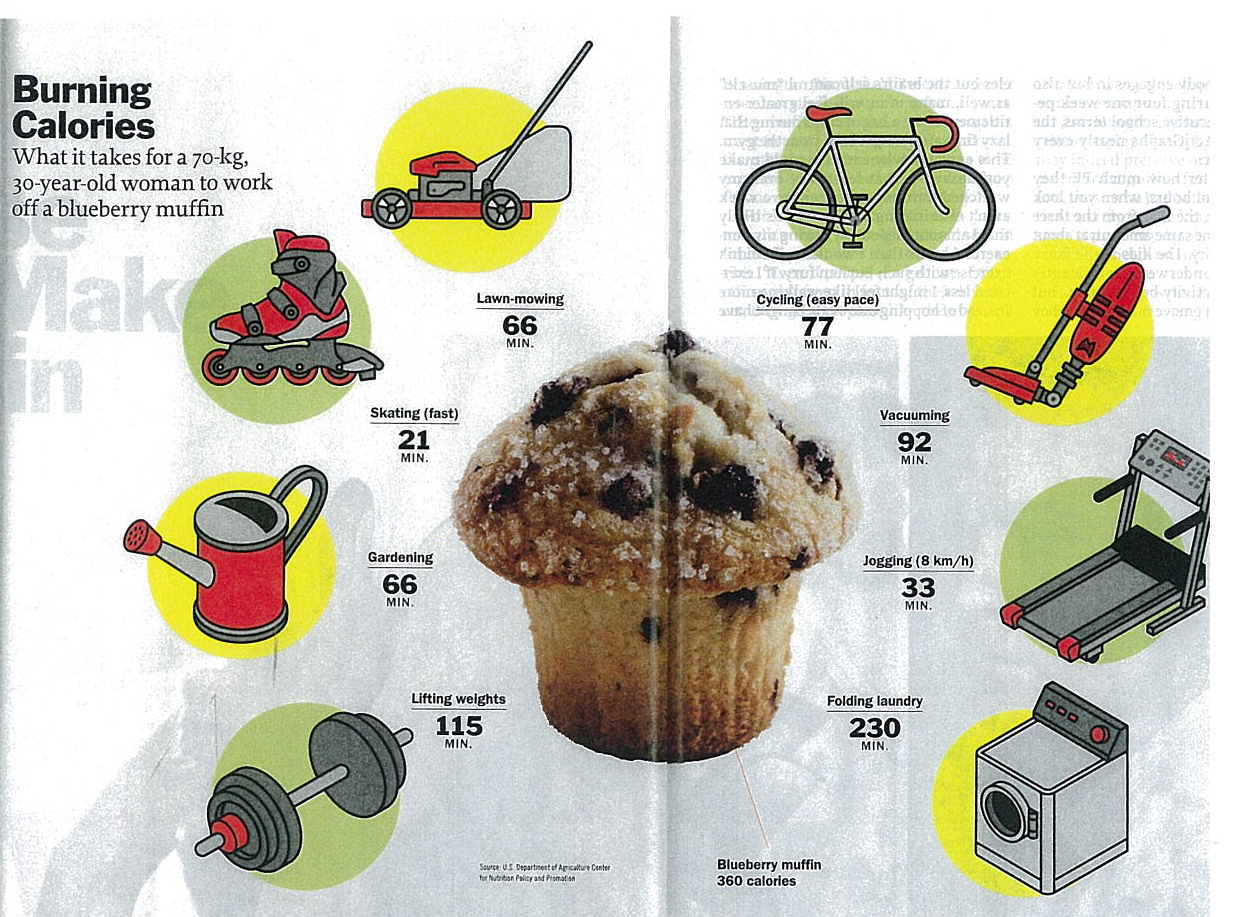
What does it take to work off a blueberry muffin?

What it takes for a 70-kg, 30-year-old woman to work off a blueberry muffin (360 calories):

  • 21 minutes of fast skating or
  • 33 minutes of jogging or
  • 66 minutes of lawn-mowing or gardening or
  • 77 minutes of cycling or
  • 92 minutes of vacuuming or
  • 115 minutes of lifting weights or
  • 230 minutes of folding laundry

Think before you eat 🙂 [photo credit: TIME magazine, August 2009]

Download free e-book: 47 simple steps to enhancing life

4 of the healthiest teas and their benefits

Following are excerpts from an article by Gina Roberts-Grey in the Oprah Magazine, July 2012 issue:

The Tea Rx. It can warm your soul or cool you off on a sweaty summer day – but did you know that tea can also prevent the formation of brain plaques associated with Alzheimer’s disease? And that’s not all: A potful of research is showing how various brews can ward off pathogens, hypertensions, even cancer. Check out these four healing cups:

  1. Darjeeling. More than half the global population harbors a pathogen called H. pylori; 15-20 percent of those people develop ailments including ulcers, gastritis, and gastric cancer. But in a recent study, scientists found that various teas inhibit H. pylori – and that Darjeeling steeped for five minutes has the greatest effect. Just hold the milk; it can block the activity of compounds in the tea.
  2. Oolong/Green. According to a study of more than 1500 subjects, a half cup to two and a half cups daily of oolong tea or the more famous health star green tea can lower a person’s risk of hypertension by 46 percent. Oolong and green tea are rich in antioxidants that help control an enzyme that raises blood pressure.
  3. Black. Four antioxidant compounds (called theaflavins) found in black tea appear to protect the brain from disease in a very specific way. Last year a group of German researchers published findings stating that these compounds prevented the formation of senile plaques, which contribute to the development and progression of Alzheimer’s and Parkinson’s.
  4. Yerba Mate. In a 2011 study, scientists added yerba mate to petri dishes containing colon cancer cells. “Put simply, the cancer cells self-destructed.” says study author Elvira Gonzalez. “Caffeine-related compounds in the tea damaged their DNA.” More research is needed but Elvira is optimistic that yerba mate could help the body fend off colon cancer.

My comments: Drinking soda or sugar coffee drinks is extremely unhealthy and unnecessary for an enjoyable life. Switching to water and (unsweetened) tea as your default drinks is not a difficult habit to form and has many health benefits.

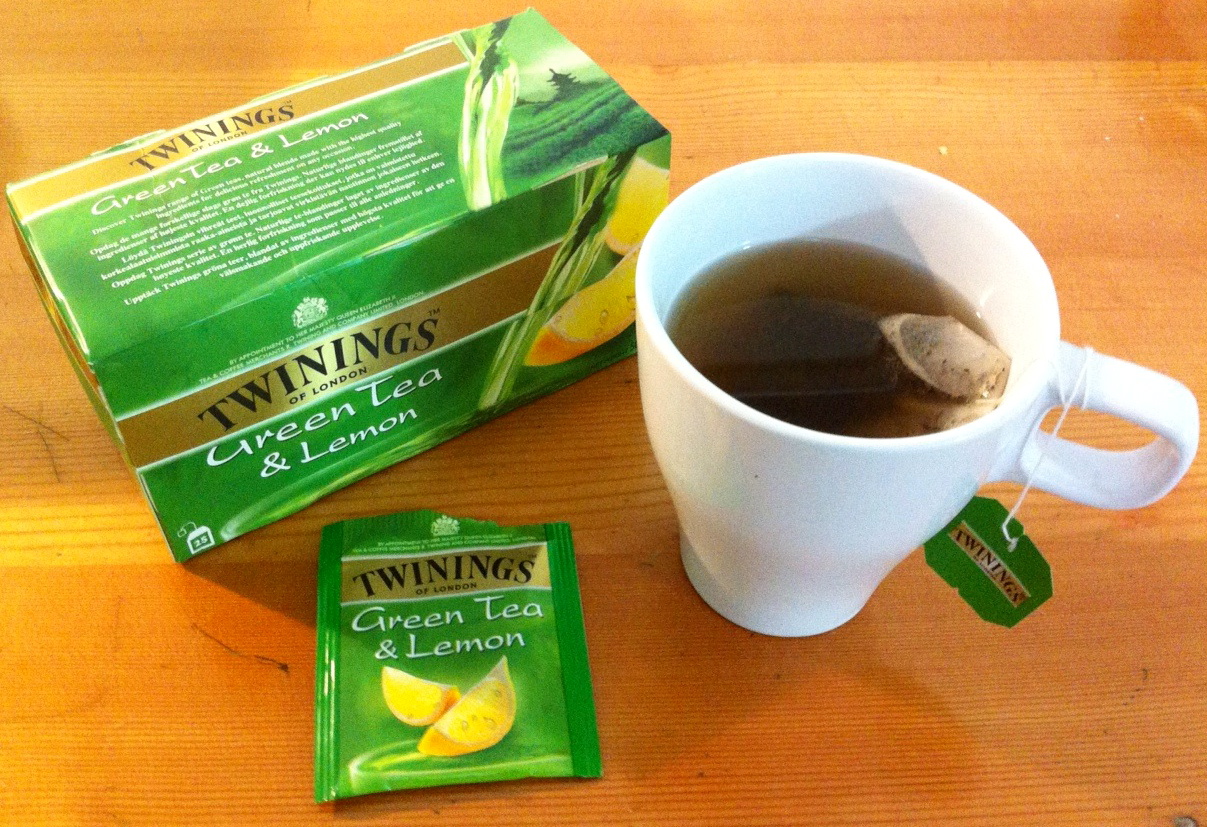
[Photo of my favorite green tea by Twinings] Read more bits on healthy habits in my book, Dhinchak Life

Inspirational eCard for free download

These eCards are made using my own photos, and are free to download and share. Some more here.

5 reasons why I travel solo sometimes

The pagoda at the Dongjiang Lake, Chenzhou

Same time last week, I was struggling with my translation app while chatting to a local family over dinner, overlooking the quiet Dongjiang Lake in a remote area of China, called Chenzhou. The family owned the small hotel I was staying in. I had no hurry to go back to my room; no plans for the next day or the day after. I was discovering the joys of traveling solo.

For most of my life, I believed traveling alone for leisure/holiday could not be fun. I even let go of many opportunities to see new places just because I didn’t have company. Sometimes the idea seemed very selfish, considering that I have a wonderful family I love to travel with. But my first solo trip to New Zeeland changed it all. I realized the benefits of traveling alone and have never missed an opportunity. After my trip to Chenzhou, a couple of friends asked me how could I travel alone to such places. And that inspired this post, which answers the why instead of how:

  1. It’s easy to pick any place you want if you don’t have to worry about the preferences of your companion(s). If the journey, place or the experience turns out to be a disaster, you don’t have anyone else to blame. I would have never picked Chenzhou of all the places!
  2. You can freely experiment destinations, modes of travel, accommodations that you have never tried before, knowing that you wouldn’t be ‘ruining’ someone else’s trip. The amazing train journey in China was a result of such an experiment.
  3. You are more likely to engage in conversations with fellow travelers during the journey, and with locals during your time on the ground. These conversations tell you more about the people and place than any guide book or the tripAdvisor.com
  4. You can make your own spontaneous plans. I was up at 5:30 and out by 6, hiking up a trail I knew nothing about, discovering the waterfalls the local family had mentioned. It was truly a path only walked by the locals living on the other side of the mountains.
  5. Traveling solo gives you time with yourself – to think, meditate, find answers or new questions, or just enjoy the beauty of the world in quiet solitude. The half an hour I spent sitting quietly at this pagoda seemed like an eternity. It was one of the toughest things to just sit and not do anything, but also the most rewarding and memorable part of the trip.

I am all in favor of enjoying holidays with family and friends, which can be great fun and some of the best bonding experiences. But traveling solo has its own joys that you must experience.

Please share your experience if you have traveled solo, or your fears if you haven’t. These eCards were part of an inspiration during the same trip. Check them out and let me know what you think.

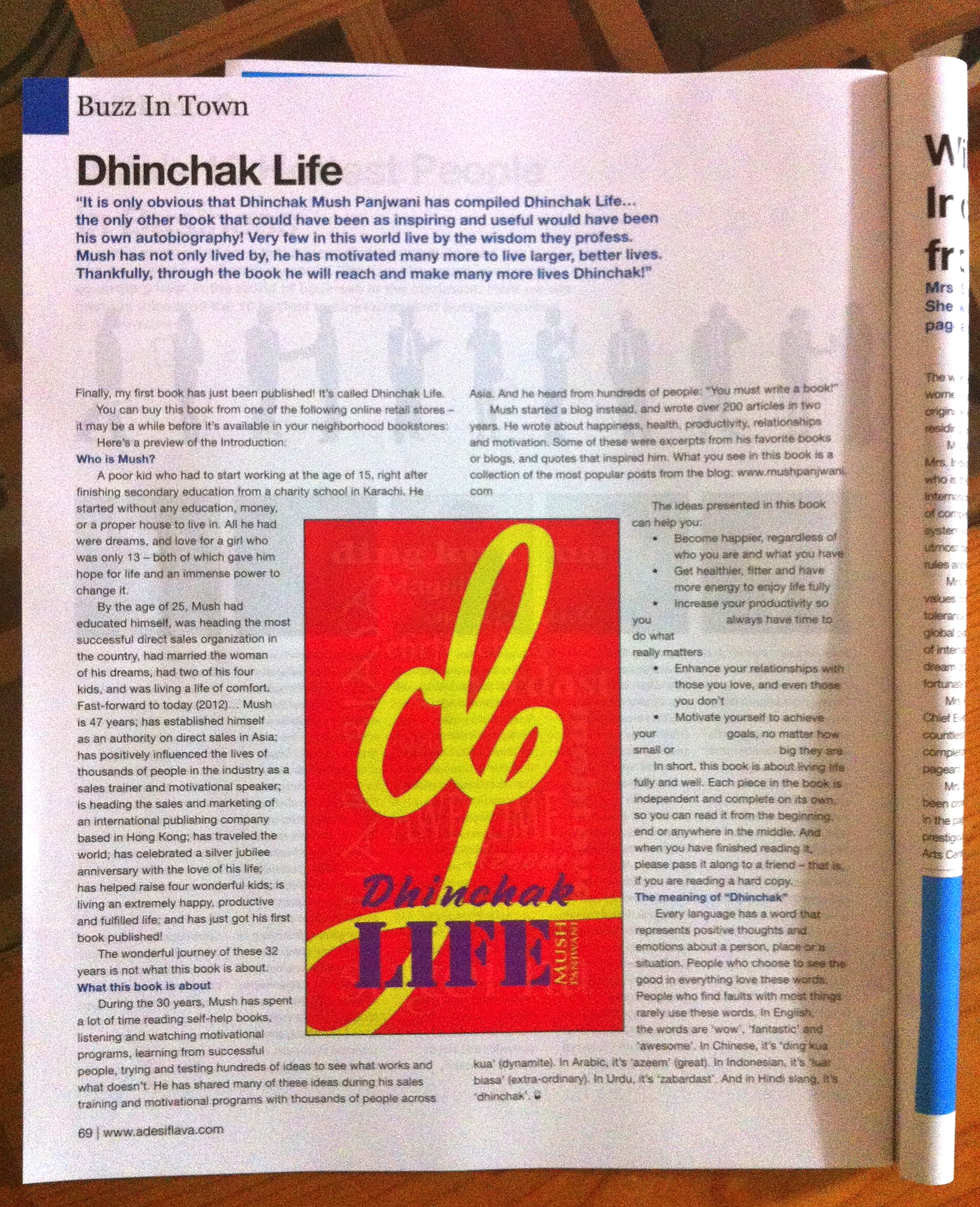
Another review of Dhinchak Life!

Just saw this in a local magazine in Hong Kong…

If you have read my book, I would love to hear from you. You can:

If you haven’t read it yet, you may order it from:

If you are in Hong Kong, you can also buy it directly from me.

Thanks to all of you for your support and encouragement!

6 ways to refuel your energy every day

Some very simple and useful tips by Tony Schwartz, author of Be Excellent at Anything, from Harvard Business Review:

Human beings aren’t meant to operate like computers — at high speeds, continuously, for long periods of time. We’re designed to be rhythmic, and to intermittently renew. Here are the six strategies we’ve found work best:

1. Make sufficient sleep your highest priority: 
Far too many of us buy into the myth that one hour less of sleep allows us one more of productivity. In fact, even very small amounts of sleep deprivation significantly undermine capacity for focus, analytic thinking and creativity. The research is clear: more than 95 per cent of us require 7-8 hours of sleep in order to be fully rested, and for our brains to optimally embed new learning. Great performers, ranging from musicians to athletes, often get even more than 8 hours. [Related post]

2. Take a renewal break at least every ninety minutes: It’s now how long you work that determines the value you produce, but rather the energy you bring to whatever hours you work.The first key is to intermittently quiet your physiology. You can dramatically lower your heart rate, your blood pressure and your muscle tension in as little as 30-60 seconds with regular practice. With your eyes closed, try breathing in through your nose to a count of three, and out through your mouth slowly to a count of six. In this way, you’re extending your recovery. As your body quiets down, your thinking mind will also get quieter and you’ll feel more relaxed.

3. Keep a running list of everything
 that you want or need to do: The more fully and frequently you download what’s on your mind, the less energy you’ll squander in fruitless thinking about undone tasks, and the more energy you’ll have to be fully present in whatever you’re doing. Continue reading

Too much work? Do less, not more.

Four simple principles of productivity from CNN today by Laura Stack. Laura Stack is president of The Productivity Pro®, Inc., and the author of What to Do When There’s Too Much to Do and four other books, including Leave the Office Earlier.

“These days, it’s seems like we are all expected to do more with less. Spending hours in the office to make sure all the assigned tasks get done bleeds into our family time, and even at home, it seems there’s a never-ending cycle of things that must be done.

Yet studies have shown that 60-hour workweeks can result in a 25% decrease in productivity. The productivity numbers get worse as the work hours increase, because exhaustion steadily erodes judgment and performance.

So what to do when there’s too much to do? The key is to do less, not more (what, you’ve never heard a time management expert tell you the key to success is to do less?).

Just say no: First, say “no” to more work. Though this might sound obvious, it’s one of the hardest things to actually do. But being realistic about the amount of additional work you can take on is as important as getting the job done. A simple, “Sorry — I’d love to help out, but I don’t have the bandwidth to take that on right now,” is sufficient.

Negotiate: When that fails, negotiate. If your boss presents you with a project you can’t outright refuse, but your plate is undeniably full, don’t hesitate to point this out. Openly discuss your current deadlines and workload, and communicate both honestly and clearly. For example, you might say, “I’m currently working on X, Y, and Z. I want to return quality work in a timely way, and if I take on this new project, it will jeopardize my promised deadlines. Would you like me to hand it off to someone else, outsource it, or would you prefer to reprioritize my existing commitments?”

Prioritize: Focus on strategic enablers of business. Everyone has too much to do, and nobody really cares how many tasks you crossed off a to-do list if key projects keep falling through the cracks. Split your to-do lists into a Master list and a High Impact Task (HIT) list.

While the Master lists tracks everything that needs to get done at some point, the HIT list includes only a reasonable number of items that can be accomplished each day, so you’re constantly focused on key priorities and work on them in the proper order:

P1: You will get fired if this isn’t done today.

P2: A valuable long-term activity that should be done soon.

P3: Someone will be unhappy if this isn’t done eventually.

P4: Human “pain-management” activities such as socializing or Facebook.

Focus: Master the skills of concentration. Stop multitasking and focus on one thing at a time. Multitasking just dilutes your attention and fools you into thinking you’re productive, when you’re really just busy.

Don’t allow people to hold distracting conversations outside your cubicle or office door either. Limit your social media usage, and anything else that can keep you from accomplishing your most important tasks.

When you find ways to do less while increasing your impact, you’ll gain more time to spend on things you actually enjoy.”

Mush’s comments: Increased productivity at work means more time with family and with yourself to do the other things you are passionate about. My own tips on productivity aren’t too different from the above.

[Photo of Cheng Chau Island, another beautiful hike during the weekend]

Read more about productivity in my new book: Dhinchak Life

The first review of Dhinchak Life!

I was thrilled to see the first review of my book on a website. The following appeared on a site called ‘Bravo Your City’:

There exist inspirational books a plenty but when one, a spectacular one, is written by a Hong Kong author – it’s a moment of pride! This article is about such a book:

The newly released Dhinchak Life by Mush Panjwani raises the bar for all other inspirational books. The short yet insightful monograph takes you through a journey of how to achieve happiness, simple steps to maximize productivity, and the secrets of achieving great health and staying fit. Unlike the rather didactic approach that may brand other inspirational books, the author does not tell you what you shall do, but rather, what one can do to achieve their goals. Here’s a snippet of what I found to be the most valuable lesson in the book:

Problems vs. situations 

There are things you can change (problems) and there are things you can’t change (situations).
Most people seem to go through life fighting with, and agonizing over, things they can’t change e.g. weather, traffic, economy, their appearance, sickness, death, accidents.

On the other hand, focusing on things we can change, improves the quality of our lives. We can change our attitudes, health, fitness, quality of our relationships, spending habits, level of our knowledge and skills, and many other things in life.

Life is too short to try and change situations.

The beauty of the book is that you don’t have to pick it up and read it start to finish (notwithstanding the fact that it’s hard to put down!). Rather, with every page Mush starts a new story that inspires or at least leaves you thinking.  Pick up a copy of my new favourite, Hong Kong author’s first book here.

Read more about Dhinchak Life here.

‘Dhinchak Life’ Kindle Edition, and 10 benefits of ebooks!

Many of you had asked about the ebook version of my first book, Dhinchak Life. The Kindle edition is now available at Amazon! And here are ten of the many benefits of ebooks over printed books:

  1. You can buy it now, without leaving your computer, as long as you have Internet access and a credit card. Kindle apps are now available for PC, Mac, Android, Windows phone, Blackberry, iPad, iPhone and iPod, for free.
  2. Ebooks are usually half the price of softcovers and one third the price of hardcovers. Dhinchak Life is USD15 for the softcover (plus shipping) while the ebook is just USD5.99.
  3. Ebooks are environmentally friendly – since you save on the paper, ink and chemicals.
  4. Ebooks don’t take up shelf space. Less stuff = less clutter = more happiness.
  5. You won’t lose your Kindle ebooks even if you lost the device you store them on. There’s always a copy on Amazon server.
  6. You can touch a word and look up the meaning instantly in the dictionary.
  7. You can highlight your favorite passages and go back to them later; you can also see what other Kindle readers have highlighted in the book you are reading, if you wish.
  8. You can share your highlighted pieces with friends on Facebook and Twitter.
  9. You can increase or decrease the font size, adjust the brightness and the background color to suit your eyes and the lighting conditions. No need for a reading lamp.
  10. You can carry all your books, those you have finished and those you are reading, with you while traveling.

Of course, you can’t share ebooks with friends and family as you share printed books. And you still have to go to bookshops if you miss the smell of printed pages. I look forward to your comments.

Tali Sharot: We are born optimists!

An excellent TED talk by Tali Sharot, neuroscientist and author of The Optimism Bias: A Tour of the Irrationally Positive Brain. She highlights the following with interesting case studies:

  1. Interpretation matters
  2. Anticipation makes us happy
  3. Optimism changes reality
  4. Optimism makes you try harder

“Whatever happens, whether you succeed or you fail, people with high expectations always feel better, because how we feel, depends on how we interpret that event.” Tali Sharot

My take: Optimism is the only way for a ‘dhinchak‘ life!