10 life lessons by Einstein

  1. Follow Your Curiosity: “I have no special talent. I am only passionately curious.”
  2. Perseverance is Priceless: “It’s not that I’m so smart; it’s just that I stay with problems longer.”
  3. Focus on the Present: “Any man who can drive safely while kissing a pretty girl is simply not giving the kiss the attention it deserves.”
  4. The Imagination is Powerful: “Imagination is everything. It is the preview of life’s coming attractions. Imagination is more important than knowledge.”
  5. Make Mistakes: “A person who never made a mistake never tried anything new.”
  6. Live in the Moment: “I never think of the future – it comes soon enough.”
  7. Create Value: “Strive not to be a success, but rather to be of value.”
  8. Don’t be repetitive: “Insanity: doing the same thing over and over again and expecting different results.”
  9. Knowledge Comes From Experience: “Information is not knowledge. The only source of knowledge is experience.”
  10. Learn the Rules and Then Play Better: “You have to learn the rules of the game. And then you have to play better than anyone else.” Source: Paolo Coelho’s blog


[Photo of an amazing flower during a recent hike in Hong Kong]

A year ago on Mush’s blog: One of the most beautiful videos…

I can’t say what moved me more, the video or the story behind it – as narrated by the videographer, Terje Sorgjerd:

“This was filmed between 4th and 11th April 2011. I had the pleasure of visiting El Teide. Spain’s highest mountain @(3718m) is one of the best places in the world to photograph the stars and is also the location of Teide Observatories, considered to be one of the world´s best observatories. 

The goal was to capture the beautiful Milky Way galaxy along with one of the most amazing mountains I know El Teide. I have to say this was one of the most exhausting trips I have done. There was a lot of hiking at high altitudes and probably less than 10 hours of sleep in total for the whole week. Having been here 10-11 times before I had a long list of must-see locations I wanted to capture for this movie, but I am still not 100% used to carrying around so much gear required for time-lapse movies.

A large sandstorm hit the Sahara Desert on the 9th April and at approx 3am in the night the sandstorm hit me, making it nearly impossible to see the sky with my own eyes.

Interestingly enough my camera was set for a 5 hour sequence of the milky way during this time and I was sure my whole scene was ruined. To my surprise, my camera had managed to capture the sandstorm which was backlit by Grand Canary Island making it look like golden clouds. The Milky Way was shining through the clouds, making the stars sparkle in an interesting way. So if you ever wondered how the Milky Way would look through a Sahara sandstorm, look at 00:32.”

5 inspiring quotes by Leo Buscaglia

  1. Don’t spend your precious time asking, ‘Why isn’t the world a better place?’ It will only be time wasted. The question to ask is ‘How can I make it better?’ To that there is an answer.
  2. The easiest thing to be in the world is you. The most difficult thing to be is what other people want you to be. Don’t let them put you in that position.
  3. Too often, we underestimate the power of a touch, a smile, a kind word, a listening ear, an honest compliment, or the smallest act of caring, all of which have the potential to turn a life around.
  4. Ancient Egyptians believed that upon death they would be asked two questions and their answers would determine whether they could continue their journey in the afterlife. The first question was, ‘Did you bring joy?’ The second was, ‘Did you find joy?’
  5. A wonderful realization will be the day you realize that you are unique in the entire world. There is nothing that is an accident. You are a special combination for a purpose – and don’t let them tell you otherwise… only you can fulfill that tiny space that is yours.

If haven’t read or heard Leo Buscaglia, please search for his talks on YouTube. His lectures on love and living are extremely motivational!

[Photo of the Bride’s Pool Waterfalls in Hong Kong, taken last week]

Read more inspiring pieces and quotes in my book, Dhinchak Life


10 health benefits of fasting

  1. Fasting promotes detoxification. As the body breaks down its fat reserves, it mobilizes and eliminates stored toxins.
  2. Fasting gives the digestive system a much-needed rest. After fasting, both digestion and elimination are invigorated.
  3. Fasting quiets allergic reactions, including asthma and hay fever.
  4. Fasting promotes the drying up of abnormal fluid accumulations, such as edema in the ankles and legs and swelling in the abdomen.
  5. Fasting normalizes blood pressure in the vast majority of cases.
  6. Fasting makes it easy to overcome addictions e.g. tobacco, caffeine and alcohol.
  7. Fasting clears the skin and whitens the eyes.
  8. Fasting restores taste appreciation for wholesome natural foods. Our taste buds come alive after fasting and food never tastes better.
  9. Fasting is the perfect gateway to a healthful diet and lifestyle. Going on a fast gives you the motivation and enthusiasm to make a fresh start.
  10. Fasting initiates rapid weight loss with little or no hunger. Most people are surprised at how little desire for food they have while fasting.

[Muslims practice 30 days of fasting every year, and it starts tomorrow!]

More health tips in my book, Dhinchak Life

Nelson Mandela’s words of wisdom

Have you ever been inspired by Nelson Mandela’s stories of the struggle for freedom, his perseverance over the 27 years in prison, his reforms during presidency, or the 250 awards he received over the last 40 years? You can read more about his inspiring life in his book, Long Walk to Freedom, or in this summary at Wikipedia. Today is Mandela’s 94th birthday, and the Nelson Mandela’s International Day. Here’s my selection of ten quotes by Mandela, starting with the one I find the most inspiring:

  1. There is no passion to be found playing small – in settling for a life that is less than the one you are capable of living.
  2. A good head and a good heart are always a formidable combination.
  3. After climbing a great hill, one only finds that there are many more hills to climb.
  4. Does anybody really think that they didn’t get what they had because they didn’t have the talent or the strength or the endurance or the commitment?
  5. Education is the most powerful weapon which you can use to change the world.
  6. If you want to make peace with your enemy, you have to work with your enemy. Then he becomes your partner.
  7. It always seems impossible until its done.
  8. Money won’t create success, the freedom to make it will.
  9. There can be no keener revelation of a society’s soul than the way in which it treats its children.
  10. We must use time wisely and forever realize that the time is always ripe to do right.

Which one did you like best?

[Photo of Cape Town City Hall, taken during my trip in December 2011. This is where Mandela gave his first public speech after being released from the prison.] Another related post.

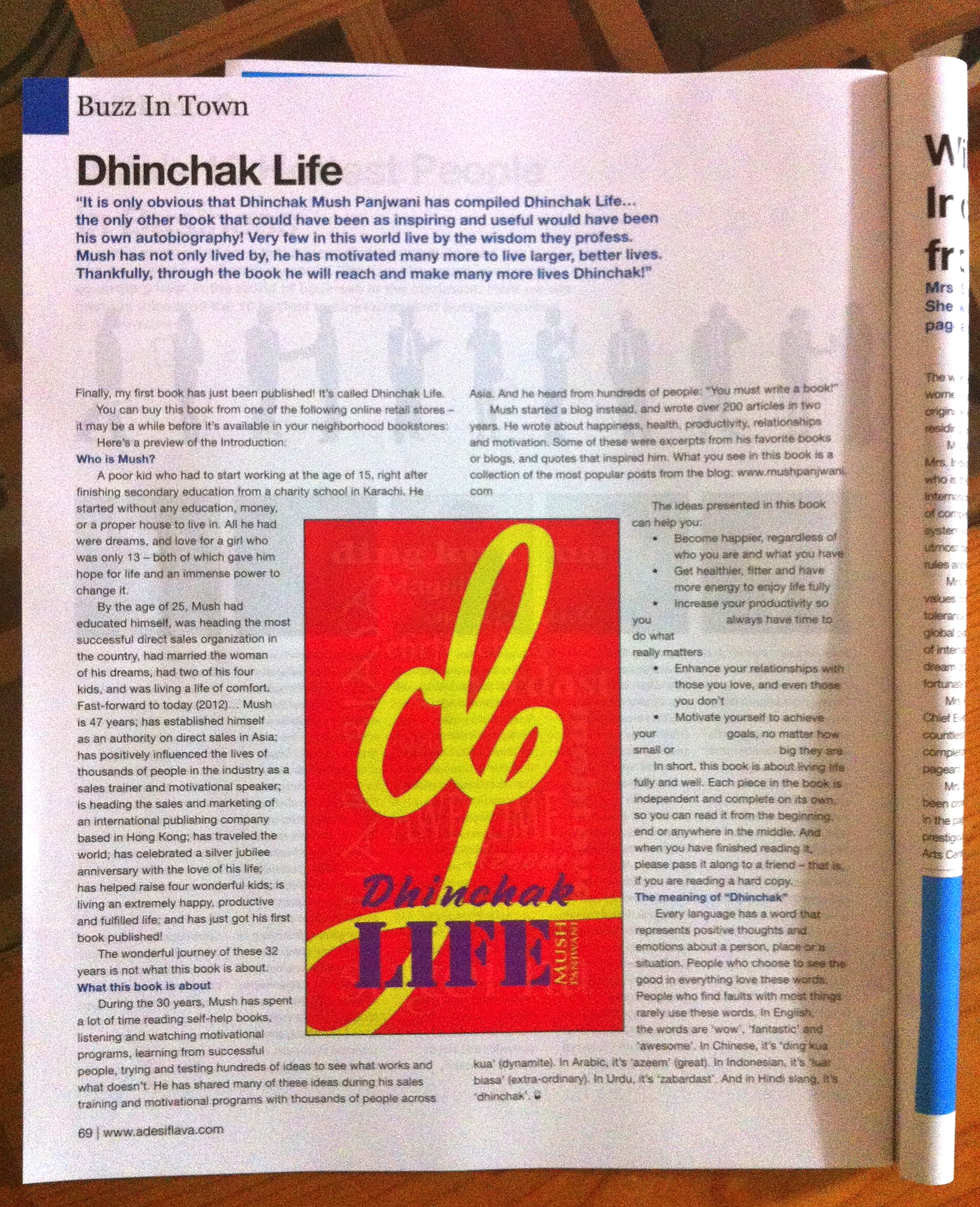
Another review of Dhinchak Life!

Just saw this in a local magazine in Hong Kong…

If you have read my book, I would love to hear from you. You can:

If you haven’t read it yet, you may order it from:

If you are in Hong Kong, you can also buy it directly from me.

Thanks to all of you for your support and encouragement!

6 ways to refuel your energy every day

Some very simple and useful tips by Tony Schwartz, author of Be Excellent at Anything, from Harvard Business Review:

Human beings aren’t meant to operate like computers — at high speeds, continuously, for long periods of time. We’re designed to be rhythmic, and to intermittently renew. Here are the six strategies we’ve found work best:

1. Make sufficient sleep your highest priority: 
Far too many of us buy into the myth that one hour less of sleep allows us one more of productivity. In fact, even very small amounts of sleep deprivation significantly undermine capacity for focus, analytic thinking and creativity. The research is clear: more than 95 per cent of us require 7-8 hours of sleep in order to be fully rested, and for our brains to optimally embed new learning. Great performers, ranging from musicians to athletes, often get even more than 8 hours. [Related post]

2. Take a renewal break at least every ninety minutes: It’s now how long you work that determines the value you produce, but rather the energy you bring to whatever hours you work.The first key is to intermittently quiet your physiology. You can dramatically lower your heart rate, your blood pressure and your muscle tension in as little as 30-60 seconds with regular practice. With your eyes closed, try breathing in through your nose to a count of three, and out through your mouth slowly to a count of six. In this way, you’re extending your recovery. As your body quiets down, your thinking mind will also get quieter and you’ll feel more relaxed.

3. Keep a running list of everything
 that you want or need to do: The more fully and frequently you download what’s on your mind, the less energy you’ll squander in fruitless thinking about undone tasks, and the more energy you’ll have to be fully present in whatever you’re doing. Continue reading

[A year ago on Mush’s blog] Keeping promises

[Here’s the original post a year ago on this blog]

This post is inspired by someone I met today in Colombo. When he decided to move back to Sri Lanka from the Middle East 15 years ago, his wife wasn’t too happy with the decision. She loved Dubai too much. This man promised his wife that he’ll bring her to Dubai for at least ten days every year. And he hasn’t missed a year since. He told me it was difficult at times to take the ten days off because of work pressure, or other priorities, ‘but a promise is a promise’.

How often do we sabotage our relationships, health, productivity, talent, dreams… by not fulfilling the commitments that we make to ourselves or others. Whether big or small, every broken promise adds up to create an unhappy situation. Some of the most commonly broken promises I can think of:

  • To our loved ones: I’ll call you back in a minute. I’ll do it during the weekend. I’ll be there for the… (birthday party or the game or the parent-teacher meeting). We’ll take a vacation this year.
  • To our kids: We’ll read it tonight. Yes, I’ll help with your math. I’ll fix it tomorrow. We’ll go there during the weekend.
  • At work: I am working on it. I’ll email you today. I’ll clean up my desk. I’ll call you back. I’ll learn the new… (skill, system, program, equipment) soon.
  • To ourselves: I’ll start exercising. I’ll read that book. I’ll eat healthy. I’m off desserts. I quit coffee. I’ll wake up earlier. I’ll clean up. I’ll volunteer. I’ll start saving.

And I am as guilty as anybody else. What about you? Let’s promise to keep our promises!

[Photo during a take-off from Hong Kong last week – totally unrelated to the topic, of course]

Read more about self motivation in my new book: Dhinchak Life

Too much work? Do less, not more.

Four simple principles of productivity from CNN today by Laura Stack. Laura Stack is president of The Productivity Pro®, Inc., and the author of What to Do When There’s Too Much to Do and four other books, including Leave the Office Earlier.

“These days, it’s seems like we are all expected to do more with less. Spending hours in the office to make sure all the assigned tasks get done bleeds into our family time, and even at home, it seems there’s a never-ending cycle of things that must be done.

Yet studies have shown that 60-hour workweeks can result in a 25% decrease in productivity. The productivity numbers get worse as the work hours increase, because exhaustion steadily erodes judgment and performance.

So what to do when there’s too much to do? The key is to do less, not more (what, you’ve never heard a time management expert tell you the key to success is to do less?).

Just say no: First, say “no” to more work. Though this might sound obvious, it’s one of the hardest things to actually do. But being realistic about the amount of additional work you can take on is as important as getting the job done. A simple, “Sorry — I’d love to help out, but I don’t have the bandwidth to take that on right now,” is sufficient.

Negotiate: When that fails, negotiate. If your boss presents you with a project you can’t outright refuse, but your plate is undeniably full, don’t hesitate to point this out. Openly discuss your current deadlines and workload, and communicate both honestly and clearly. For example, you might say, “I’m currently working on X, Y, and Z. I want to return quality work in a timely way, and if I take on this new project, it will jeopardize my promised deadlines. Would you like me to hand it off to someone else, outsource it, or would you prefer to reprioritize my existing commitments?”

Prioritize: Focus on strategic enablers of business. Everyone has too much to do, and nobody really cares how many tasks you crossed off a to-do list if key projects keep falling through the cracks. Split your to-do lists into a Master list and a High Impact Task (HIT) list.

While the Master lists tracks everything that needs to get done at some point, the HIT list includes only a reasonable number of items that can be accomplished each day, so you’re constantly focused on key priorities and work on them in the proper order:

P1: You will get fired if this isn’t done today.

P2: A valuable long-term activity that should be done soon.

P3: Someone will be unhappy if this isn’t done eventually.

P4: Human “pain-management” activities such as socializing or Facebook.

Focus: Master the skills of concentration. Stop multitasking and focus on one thing at a time. Multitasking just dilutes your attention and fools you into thinking you’re productive, when you’re really just busy.

Don’t allow people to hold distracting conversations outside your cubicle or office door either. Limit your social media usage, and anything else that can keep you from accomplishing your most important tasks.

When you find ways to do less while increasing your impact, you’ll gain more time to spend on things you actually enjoy.”

Mush’s comments: Increased productivity at work means more time with family and with yourself to do the other things you are passionate about. My own tips on productivity aren’t too different from the above.

[Photo of Cheng Chau Island, another beautiful hike during the weekend]

Read more about productivity in my new book: Dhinchak Life

The first review of Dhinchak Life!

I was thrilled to see the first review of my book on a website. The following appeared on a site called ‘Bravo Your City’:

There exist inspirational books a plenty but when one, a spectacular one, is written by a Hong Kong author – it’s a moment of pride! This article is about such a book:

The newly released Dhinchak Life by Mush Panjwani raises the bar for all other inspirational books. The short yet insightful monograph takes you through a journey of how to achieve happiness, simple steps to maximize productivity, and the secrets of achieving great health and staying fit. Unlike the rather didactic approach that may brand other inspirational books, the author does not tell you what you shall do, but rather, what one can do to achieve their goals. Here’s a snippet of what I found to be the most valuable lesson in the book:

Problems vs. situations 

There are things you can change (problems) and there are things you can’t change (situations).
Most people seem to go through life fighting with, and agonizing over, things they can’t change e.g. weather, traffic, economy, their appearance, sickness, death, accidents.

On the other hand, focusing on things we can change, improves the quality of our lives. We can change our attitudes, health, fitness, quality of our relationships, spending habits, level of our knowledge and skills, and many other things in life.

Life is too short to try and change situations.

The beauty of the book is that you don’t have to pick it up and read it start to finish (notwithstanding the fact that it’s hard to put down!). Rather, with every page Mush starts a new story that inspires or at least leaves you thinking.  Pick up a copy of my new favourite, Hong Kong author’s first book here.

Read more about Dhinchak Life here.

Gallery of Insight- Windows To The World

“Do just once what others say you can’t do, and you will never pay attention to their limitations again.”

-James Cook

Meet Wim Hof. http://en.wikipedia.org/wiki/Wim_Hof#Feats

Just your regular run-of-the-mill Dutchman, except for the fact that he held the world record for being immersed in an ice bath for the longest time, he climbed Everest and ran a marathon in the Arctic circle wearing only a pair of shorts, and ran a marathon in the Namib Desert without a drop of water. He also claimed that these feats “were easy”. How, you ask?

With intense concentration and meditation, Wim Hof has become able to exhibit a rarely-seen ability to control his own immune response and autonomic nervous system. An article I read (link below post) goes into detail about how he was the only test subject out of 240 other people who was able to suppress his immune response when administered an…

View original post 397 more words

Is happiness the secret of success?

I just read this wonderful article by Shawn Achor at CNN.com. Following are some excerpts. You may read the full article here.

“Scientifically, happiness is a choice. It is a choice about where your single processor brain will devote its finite resources as you process the world. If you scan for the negative first, your brain literally has no resources left over to see the things you are grateful for or the meaning embedded in your work. But if you scan the world for the positive, you start to reap an amazing advantage.

“Now that there is research validity to these claims, the working world is starting to take notice. In January, I wrote the cover story for the Harvard Business Review magazine on “Happiness Leads to Profits.” Based on my article called “Positive Intelligence” and my research in The Happiness Advantage, I outlined our researched conclusion: the single greatest advantage in the modern economy is a happy and engaged workforce.

“A decade of research in the business world proves that happiness raises nearly every business and educational outcome: raising sales by 37%, productivity by 31%, and accuracy on tasks by 19%, as well as a myriad of health and quality-of-life improvements.

“Training your brain to be positive at work is just like training your muscles at the gym. Sounds simple, right? Well, think about how easy it is to make yourself go to the gym. The key with any new resolution is to make it a habit. New research on neuroplasticity – the ability of the brain to change even as an adult – reveals that moderate actions can rewire the brain as you create “life habits.” Continue reading

As happy as possible – by Leo Babauta

Reblogged from mnmlist.com – one of my favorite blogs about minimalism.

“I believe I’m as happy as it is possible to be.

I’m not crying out in ecstatic pleasure, or streaming tears of joy, but I am very happy. It’s not a peak of happiness, but a plateau of happiness that can go on for as long as I live.

This is a happiness I wish on everyone alive. The question then is, what are the factors that contribute to my happiness?

Here’s what I don’t have:

  1. A huge house
  2. Massive wealth
  3. Fancy clothes
  4. A nice car
  5. A powerful job
  6. Cable TV

And I don’t believe having any of those would contribute to greater happiness than I already have. Here’s what I do have that contribute to my happiness:

  1. Time
  2. Loving relationships
  3. Meaningful work
  4. Health
  5. Books
  6. Enough

The first six are seen as the goals of society by many people. The second six make me very happy, and I believe I have them because I decided to forgo the first six. I recommend this path.”

Read more about happiness in my new book: Dhinchak Life

‘Dhinchak Life’ Kindle Edition, and 10 benefits of ebooks!

Many of you had asked about the ebook version of my first book, Dhinchak Life. The Kindle edition is now available at Amazon! And here are ten of the many benefits of ebooks over printed books:

  1. You can buy it now, without leaving your computer, as long as you have Internet access and a credit card. Kindle apps are now available for PC, Mac, Android, Windows phone, Blackberry, iPad, iPhone and iPod, for free.
  2. Ebooks are usually half the price of softcovers and one third the price of hardcovers. Dhinchak Life is USD15 for the softcover (plus shipping) while the ebook is just USD5.99.
  3. Ebooks are environmentally friendly – since you save on the paper, ink and chemicals.
  4. Ebooks don’t take up shelf space. Less stuff = less clutter = more happiness.
  5. You won’t lose your Kindle ebooks even if you lost the device you store them on. There’s always a copy on Amazon server.
  6. You can touch a word and look up the meaning instantly in the dictionary.
  7. You can highlight your favorite passages and go back to them later; you can also see what other Kindle readers have highlighted in the book you are reading, if you wish.
  8. You can share your highlighted pieces with friends on Facebook and Twitter.
  9. You can increase or decrease the font size, adjust the brightness and the background color to suit your eyes and the lighting conditions. No need for a reading lamp.
  10. You can carry all your books, those you have finished and those you are reading, with you while traveling.

Of course, you can’t share ebooks with friends and family as you share printed books. And you still have to go to bookshops if you miss the smell of printed pages. I look forward to your comments.

The End of Illness – by David Agus

I’ve been reading this very interesting book that introduces a whole new way of looking at illness and health. It’s filled with practical suggestions, including:

  • How taking multivitamins and supplements could significantly increase your risk for cancer over time.
  • Why sitting down most of the day, despite a strenuous morning workout, can be as bad or worse than smoking.

Here are a couple of pieces from the book:

“Globally, more than 1 billion adults are overweight, with at least 300 million of them obese. Obesity in adults and children, male and female, has doubled over the past forty years, with the biggest increase seen since 1980. Obesity and being overweight pose a major risk for chronic diseases, including type 2 diabetes, cardiovascular disease, hypertension and stroke, and certain forms of cancer. In fact, it’s estimated that every third person born in 2000 will have type 2 diabetes as an adult.”

“Why, in this age of plenty, do we have to rely on manufactured pills to get our vitamins and other nutrients? Why are we so out of touch with our own reality? One of the main reasons we are estranged from real meals today that are close to nature is because fast and processed foods abound. Another is we are led to believe that we will be healthier and feel better if we boost our intake of vitamins and nutrients through pills, powders, elixirs, juices, and the like. Antioxidant in particular has become a buzzword of the boomer generation, and antioxidant products, alongside other formulas such as resveratrol, which promise to reverse all the signs and symptoms of aging, are marketed today as though they represent the fountain of youth. Ironically, it is estimated that one-third of adults in high-income countries (which means that they have access to the best, most nutrient-dense foods that money can buy) consume antioxidant supplements. But what, if anything, does taking antioxidant supplements really do? The answer might surprise you.”

I have never been a fan of multivitamins or supplements, and the material presented in this book leaves no doubts. Here’s a link to buy the Kindle edition from Amazon.

Read about my first book, Dhinchak Life, here.

What’s a 3-day monk?

I learnt a new phrase today: Being a 3-day monk. It’s a direct translation of a Japanese term, “Mikka Bouzu” (me-kah boh-zu). A 3-day monk is a person who starts a new project with a lot of commitment and passion, only to give it up soon and move on to something else. It could be a new diet plan, exercise routine, language course, music lesson, quitting a bad habit, starting a good habit… anything that takes time and consistency to be effective.

We are all guilty of being a 3-day monk for one thing or the other. Why do we quit so easily? Why is it so difficult to pursue anything with consistency? What would it take to be a 30-day or 300-day monk?


[Photo of a Shaolin Monk demonstrating his superior balancing skills learnt over years of practice]

PS. My first book, Dhinchak Life, was written over a period of two years – one piece per week.

Two ways of not achieving your goals

  1. Not starting at all.
  2. Not going all the way.

[Photo during one of the McLehose Trails in Hong Kong]

Find more inspiration in my new book: Dhinchak Life

4 reasons why today is your best day!

A piece from “Today is Your Best Day” by Roy Lessin:

It’s not your best day because you feel like it is, or because you prevent that it is. It is not your best day because everything is going perfectly, or because you are living in ideal circumstances. It is not your best day because you are in optimum health, or because everything is going you way.

Here are four reasons why today is your best day:

  1. Today is your best day because you are here. God has placed you in this moment of time for a purpose, and the things that happen to you today will be an unfolding of that purpose.
  2. What happened to you yesterday, however easy or difficult, was used by God to help prepare you for what he has for your today.
  3. God will use what happens today to prepare you for what he has for you in future days.
  4. God has used your past and worked it all together for the good, and he will use this day to add to the good that he has already worked on your behalf.

God doesn’t make bad days for your and good days for you. God makes each day fit perfectly into his plans for you.

[Photo of sunrise from one of the McLehose Trails in Hong Kong]

Read more inspiring pieces in my new book, Dhinchak Life

Tali Sharot: We are born optimists!

An excellent TED talk by Tali Sharot, neuroscientist and author of The Optimism Bias: A Tour of the Irrationally Positive Brain. She highlights the following with interesting case studies:

  1. Interpretation matters
  2. Anticipation makes us happy
  3. Optimism changes reality
  4. Optimism makes you try harder

“Whatever happens, whether you succeed or you fail, people with high expectations always feel better, because how we feel, depends on how we interpret that event.” Tali Sharot

My take: Optimism is the only way for a ‘dhinchak‘ life!

My first book has just been published: Dhinchak Life!

ImageFinally, my first book has just been published! It’s called Dhinchak Life. 

It’s a compilation of the best posts from this blog, organized into seven sections: Happiness, Health & Fitness, Productivity & Achievements, Inspiring Lives, My Travelogue, Quotes that Inspire, and Recommended Reading. The ideas presented in this book can help you:

  • Become happier, regardless of who you are and what you have
  • Get healthier, fitter and have more energy to enjoy life fully
  • Increase your productivity so you always have time to do what really matters
  • Enhance your relationships with those you love, and even those you don’t
  • Motivate yourself to achieve your goals, no matter how small or big they are

Please read the Introduction of the book here. It includes the meaning of Dhinchak, and how to buy too.

Thanks to everyone who helped make this possible.