Eat Slowly; Get Slimmer!

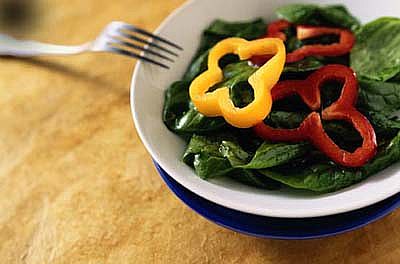
0910 saladThe risks of speed eating were recently published in the British Medical Journal:

“Japanese researchers queried nearly 3,300 people about eating habits and discovered that those who reported eating quickly until they felt full were three times as likely to be overweight as slow eaters who stopped before they were full.”

I find it interesting that this study was done in Japan, because in Okinawa, a place known for its healthy and long-lived populace, there is a saying – hara hachi bu – which loosely translates “Eat until 80% full.” If you have a tough time slowing your pace of eating, do what the Okinawans do. There’s no guarantee, but you have nothing to lose but weight.

10 Reasons for not Exercising

Let’s take Trevor’s idea one step further, let’s find out the reasons why people don’t exercise. Please tell us your reasons through this poll – full confidentiality guaranteed:

You can still participate in the What Makes You Happy? poll.

Health – Hard Talk, by Trevor Lunn

Trevor Lunn has been one of my best friends, mentors and inspiration for almost two decades. At 60+ he is healthier and fitter than most people half his age. He recently left his long-term publishing career to pursue his dream of getting a degree in Health Sciences. Now he is a full-time university student in Melbourne, majoring in exercise science, psychology and nutrition. He has agreed to share his knowledge and wisdom about health and fitness through this blog. Here’s the first one:

Welcome to Health – Hard Talk. Here will not be found “handy hints and tips” or the latest headlines about “health research” reported in the media, or the supposed quick fixes or mystical herbal or alternative remedies. Here there are no easy, comforting words intended to lull you into the belief that there is little that you can do to improve your own health status; that it’s all in your genes or your circumstances make it unavoidable.

What you will find is ideas and recommendations drawn from high quality scientific literature. They will not be my ideas. They will come mainly from epidemiological studies conducted by the World Health Organization and governments and from scientific research published in peer-reviewed, reputable journals. For now references will not be provided though they can always be requested.

This journey is intended to help you understand where you are with your health compared to the population, what risks you expose yourself to and, hopefully, how you can address these risks and move towards a healthier life. Join me and see where the journey takes you.

Here’s a starting and perhaps startling thought. The leading modifiable risk factor for all-cause mortality world-wide is cigarette smoking. The second is physical inactivity. Putting that into simple language, cigarette smoking kills more people than any other risky behavior and physical inactivity kills more than any of the rest.

If you are in the majority, you do not exercise enough. What’s enough? We’ll get into the detail of that later, but the quick answer is 30 minutes of moderately vigorous activity at least five days a week. Why don’t you do it? Here’s a useful exercise to try. It’s called a Decisional Balance by psychologists. Draw a simple table with two columns side by side. Head one “pros” and the other “cons” Now write down under the “pros” heading all the positive outcomes you think would result from exercising and in the “cons” column all the possible negative outcomes.

Post your answers and we’ll start our journey.
What makes you happy? Preliminary results!

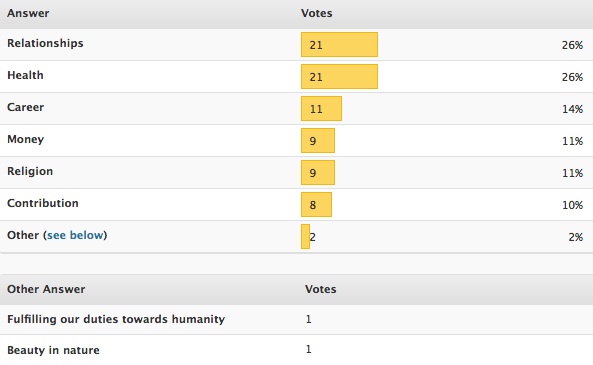
Here’s what it looks like, so far:

poll-resultsBut that’s just based on 81 votes! Do you think the results would change much if we had 800 votes instead? Please help get some more votes, and let’s find out.

A respected friend of mine asked me the purpose of this survey, and whether I guarantee confidentiality. Yes, absolutely. I can only see this chart – no names or anything else. And the purposes of the survey are a) personal curiosity and b) obtain interesting statistics to share with my readers. Fair enough?

Six things for happiness!

What do you think really makes people happy? I have wondered this question for years. Is it money that allows you to buy the things and do the things that you like? Or is it strong relationships – people you love, and people who love you? Or is it success in your chosen career and the recognition that comes with it? Or optimum health, fitness and energy to enjoy life to the fullest? Or a religion that connects you to a higher being and guides you to do right? Or does it come from contribution to community or society or mankind or other life or our planet earth?

What makes you happy? Please take this poll and tell us. Please limit to three of the six choices. Get your friends to take this poll too. The more participants, the clearer the answer.

Jill Bolte Taylor studied her own stroke!

Learn about the human brain, the miracle of life and how we are all connected to each other and the universe. Watch this presentation by brain researcher Jill Bolte Taylor who studied her own stroke as it happened!

It was one of the ten most popular presentations since TED opened the talks to public two years ago. Watch it here.

A Confession!

mdI had breakfast from McDonald’s! An Egg McMuffin and a Hash Brown. Later during the day, I checked the amount of damage done at “McDonald’s nutrition facts” site:

  • Calories: 450
  • Calories from fat: 190
  • Total fat: 21 grams
  • Cholesterol: 260 mg

To put the 450 calories in perspective: I’d need to jog for 30 minutes, or swim for 45 minutes, or walk for an hour and a half to burn that many calories! And the fat and cholesterol will still keep me guilty forever. But this confession has made me feel much better 🙂

The Weekly Round-Up: An Introduction

First post by our new contributor, Hamza:

How’s it going readers? Starting from today, I’ll be putting up a couple of links from around the blogosphere of articles that are either a must-read, extremely useful, or just plain interesting. These will of course be sticking to the themes of healthy living, productivity, business, personal finance, inspiration and life in general.

Without further ado, here are 8 interesting articles for the week ending Sunday, 12/04.

Stay tuned for the next weekly round-up!

Randy Pausch’s last lecture

I am sure most of you have heard or read about Professor Randy Pausch by now. But just in case you haven’t… his work is not to be missed!

Randy Pausch (Oct. 23, 1960 – July 25, 2008) gave his last lecture at the Carnegie Mellon University on Sept. 18, 2007. In his moving presentation, “Really Achieving Your Childhood Dreams,” Pausch talked about his lessons learned and gave advice to students on how to achieve their own career and personal goals. His book, “The Last Lecture” which was based on this presentation was also a bestseller. You can watch that lecture here. It’s about an hour, but very inspiring from beginning to end:


Make Today Count by John Maxwell

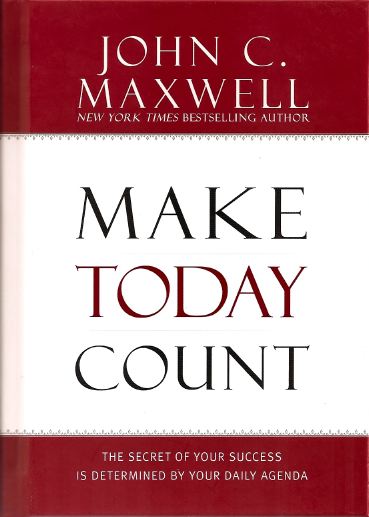
maketodaycountI was just looking; I wasn’t going to buy anything. Until I saw this little book with a bold red and white cover and an interesting title. In fact, I liked the subtitle even better. I read it on the flight back from Singapore last month, and started re-reading it this week. Here’s a piece from the Introduction:

You will never change your life until you change something you do daily. You see, success doesn’t just suddenly occur one day in someone’s life. For that matter, neither does failure. Each is a process. Every day of your life is merely a preparation for the next. What you become is the result of what you do today. In other words… you are preparing for something. The way you live your life today is preparing you for tomorrow. The questions is, What are you preparing for? As my father used to tell me when I was growing up, “You can pay now and play later, or you can play now and pay later. But either way, you are going to pay.”

The book has twelve chapters – a dozen to focus on daily: Attitude, Priorities, Health, Family, Thinking, Commitment, Finances, Faith, Relationships, Generosity, Values and Growth. I’ll be happy to give my copy to the first person who asks.

Health Calculators

Thee very useful links for anyone concerned about calories in our food and other health indicators:

Calories Burned provides a calcalutor where you input your weight, activity and duration. A 76-kg person can burn 44 calories while sitting and blogging for half an hour, or 153 calories by swimming for the same amount of time!

Calories Calculator is a helpful tool to measure the amount of calories and fat in what we eat. E.g. a medium size banana has only 0.6 gm of fat and 105 calories, while half a cup of banana chips have 16 gm of fat and 239 calories!

Health Calculators is part of Medindia.com that offers many useful calculators e.g. heart rate, blood pressure, stress meter, drugs directory, calories in Indian food, teeth chart and even world population and death clocks!

If you want to control your weight but find calorie counting too complicated, stay tuned for the next post on easy steps to better health and fitness.

Health Facts

Some useful facts from Women’s Health (April issue):

  • Increasing your water consumption by one liter a day for a year can result in five pounds of weight loss.
  • Obese people are more likely to develop age-related macular degeneration – AMD, a disease that destroys part of the eye responsible for seeing detail.
  • Eating red meat increases the risk of malignant tumors.
  • How much more likely you are to be overweight if you eat quickly and until you feel full: 3 x

Calculate your BMI (Body Mass Index)

A good first step towards improving your health is to bring your weight to normal. And BMI is supposed to be the best indicator of whether you are ‘normal’, ‘overweight’ or ‘obese’.

Here’s a useful calculator to calculate BMI.

You can also download a ready reference table where you can match your height and weight to find out your BMI. There are other more accurate ways which take into account gender and frame etc. but this one is a good start.

How to achieve and maintain a ‘normal’ weight is another story 🙂

Oscar Pistorius – fastest man with no legs!

PistoriusWhen Oscar Pistorius‘ lower legs were amputated at age 1, few would have banked on this South African challenging world-class sprinters. At 20, when he began to close in on Olympic-qualifying time for 400m, experts posited that his times were so good, he must have been getting an unfair advantage from his bladelike prosthetics. When he set his sights on the Olympic Games in Beijing, the International Association of Athletics Federation (IAAF) ruled he couldn’t compete against able-bodied athletes.

Living with prosthetic legs was seen as a huge impediment, but he has turned this prescription upside down. His disadvantage has become the advantage. It’s too easy to credit Pistrius’ success to technology. Through birth or circumstances, some are given certain gifts, but it’s what one does with those gifts, the hours devoted to training, the desire to be the best, that is at the true heart of a champion.

(Adapted from TIME magazine, written by Erik Weihenmayer – the only blind person to conquer Mount Everest)

Lance Armstrong – an inspiration for all

lanceThere’s no one else quite like him. And there probably never will be. The best cyclist ever, Lance won the Tour de France, an almost incomprehensible seven times from 1999 to 2005. But before he could do that, in 1996 he had to beat back a cancer that was supposed to take his life. Testicular cancer had spread to his abdomen, lungs and brain. Doctors told him he had no chance. But no chance were not words that had meaning for Lance.
He spearheaded the Lance Armstrong Foundation, which made a yellow plastic loop a statement of resistance and strength across the entire planet. It advocates for those living with cancer, funds research, inspires the cancer community to support each other.

Lance took a minor sports in America and turned it into a great national passion and pride. And he did it by struggling for years, alone on his bike, often in unforgiving weather, over terrain that most of us would view as hostile, when no one was watching, no one was cheering.

He inspired all of us who face a cancer diagnosis to search out the doctors who believe that we can live, to hold on to friends and family that stand beside us – and then to fight to prove the faith of those. After Lance, no one could ever again say it was too hard, the odds were too high, the fight already lost. Watch one of his recent interviews here.

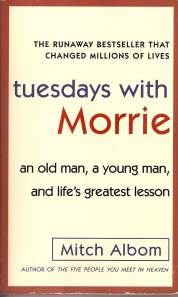
Tuesdays with Morrie by Mitch Albom

tuesdaysA true story of a dying professor who shares his wisdom with the author. Very inspiring and thought-provoking stuff on life, death, family, money, emotions, love and more. Here’s an excerpt from the Tuesday they talk about money:

“We’ve got a form of brainwashing going on in our country. Do you know how they brainwash people? They repeat something over and over. Owning things is good. More money is good. More property is good. More is good. More is good. We repeat it – and have it repeated to us – over and over until nobody bothers to even think otherwise. The average person is so fogged up by all this, he has no perspective on what’s really important anymore.

“Wherever I went in my life, I met people wanting to gobble up something new. Gobble up a new car. Gobble up a new piece of property. Gobble up the latest toy. And they wanted to tell you about it. ‘Guess what I got? Guess what I got?’ These were people so hungry for love that they were accepting substitutes. But it never works. You can’t substitute material things for love or for gentleness or for tenderness. I can tell you, as I am sitting here dying, when you most need it, neither money nor power will give you the feeling you’re looking for, no matter how much of them you have.”

Excuses for Not Exercising

Some excerpts from an article in this month’s The Oprah Magazine:

“I am already too busy – I can’t deal with one more thing I’m supposed to do.” Too many women put their jobs, obligations, and the people they care for before themselves. Most women wouldn’t say out loud, ‘I am not as important and I don’t deserve the time’, but that’s exactly what their actions say. Try justifying regular trips to the gym by reminding yourself that unless your needs are met, you’ll have trouble meeting the needs of those counting on you.

“How can I exercise when I am always tired?” First you have to realize that there are two types of energy – physical and mental – and they feed off each other. Chances are, you’re mentally tired from sitting at your job all day, and you need to get your blood circulating to rev your engine again. Tell yourself, I will do just ten minutes. And call it quits if you are still slogging after ten full minutes.

“I’ll start out gung ho, but I know I’ll get bored and quit.” Predicting failure is a classic way of protecting yourself. Rule out success, and you don’t have to try. If you are put off by the thought of setting up an effective program, consider spending a bit extra on a personal trainer to get you through the challenging first few weeks.

The Secret by Rhonda Byrne

secret.jpgA great motivational book about the power of our thoughts and how to apply it in our lives. A superb team of authors, teachers and speakers bring you The Secret to health, wealth, relationships and happiness.