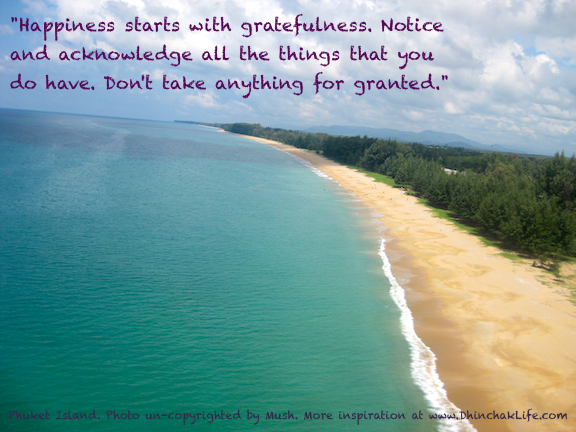
More iCards (inspiration cards) here.

A section from my ebook, ‘47 Tips for Enhancing Life‘. On happiness:
You may download the free photo ebook from here.
[Photo taken recently around Phi Phi Island in Phuket]
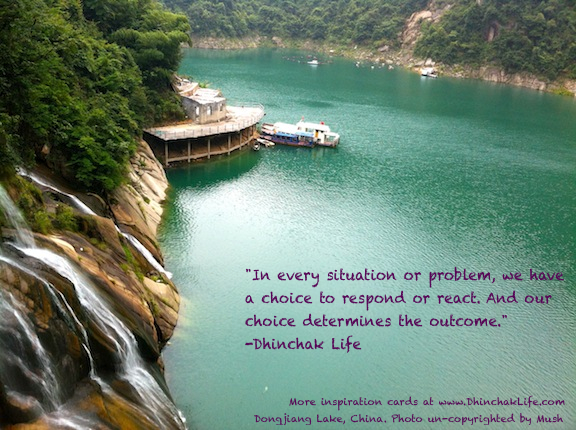
What’s the difference between problems and situations, or responding and reacting? Related post.
Why ‘Happy New Week?’ Related post.
Did you read about the official launch of my book: Dhinchak Life?

Whether or not you are a great storyteller or not, you surely are a great story-maker. In fact, most of us are!
You get the idea? These are all the beginnings of great stories – mostly fiction. Question is, why do we mostly choose to make stories that make us unhappy, sad, depressed, angry, frustrated or disappointed? And the problem is, our stories affect our beliefs and actions. Negative stories usually result in negative actions.
If we are going to make stories, why not make positive ones that make us happy, smile, laugh, and feel good about ourselves and other people e.g.
Try giving people the benefit of doubt. Try to make positive stories, and see if they result in positive actions – yours and others’.
We all have those moments when we feel low, unhappy or a bit depressed. Somebody said something that hurt. Someone didn’t notice your good work and you felt bad. Your actions didn’t produce the desired results, and you got depressed. The problem with such feelings is the negative cycle they create, so it’s important that you quickly reverse the emotions. There are many ways to do that, but the one that takes the least amount of time and effort is gratefulness.
 Sit in a quiet place, close your eyes and think of 30 good things in your life that you may be taking for granted e.g.
Here’s another very useful shopping strategy to keep life simple and uncluttered. If it’s anything other than the basic necessities, it must do one of the three things:
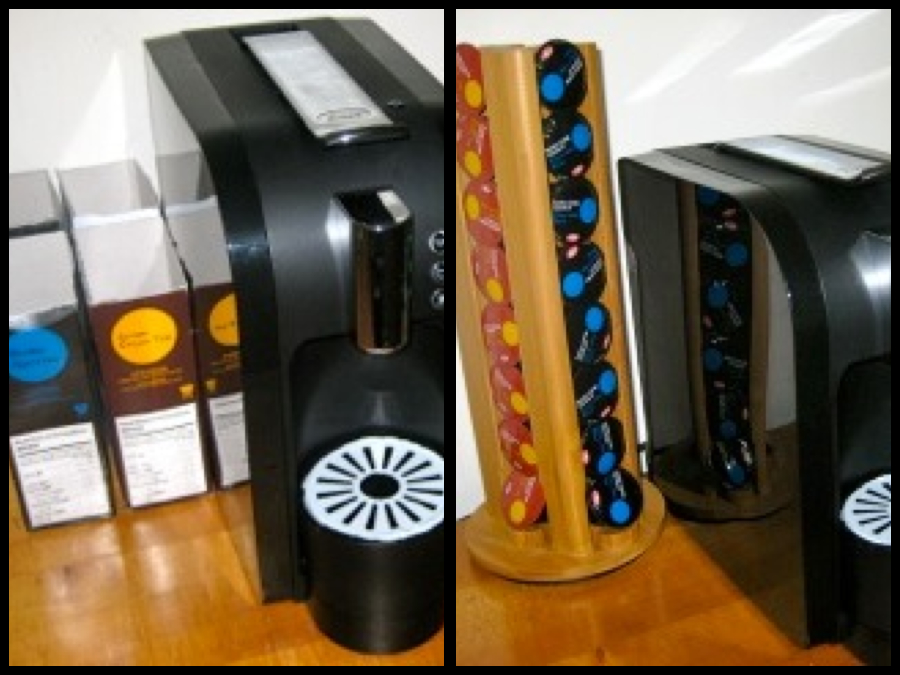
If it does, I allow myself the pleasure of impulse buying. The following wooden stand that I bought today is such an example. It helps keep the coffee capsules organized and tidy, replacing the boxes. The photo shows before and after.
Do you think the three questions can save you some money, time or space?
Related post: 3 rules for guilt-free shopping
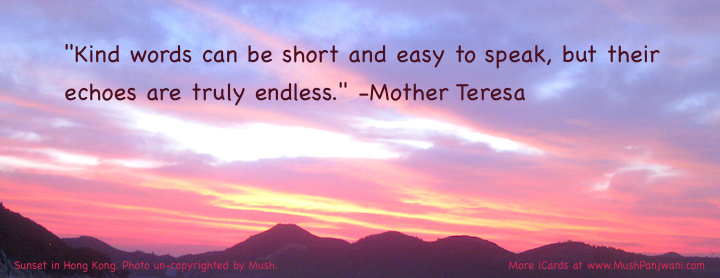
All of us have experienced the positive feeling when someone says something nice to us and we know they mean it. A genuine compliment or appreciation often takes 2-3 words but can result in instant happiness and an immediate shift in your mood. Here’s a list of some of those 2-3 word phrases that can change somebody’s life, even if for a few hours or days – of course, you can’t use all of these with everyone:
I think someone’s quality of life and level of happiness can be measured in the number of compliments they give and receive. What was your last compliment?
“Too often we underestimate the power of a touch, a smile, a kind word, a listening ear, an honest compliment, or the smallest act of caring, all of which have the potential to turn a life around.” -Leo Buscaglia

I wasn’t sure about the best title for this post. So I wrote all three of them. I wasn’t even sure if this photo post belongs here where I only share tips on happiness, health, productivity, relationships and motivation. But I hope these photos inspire some reader somewhere to take a break from a busy day and enjoy the amazing beauty of nature, whether it be sunrise, sunset, water, hills, snow, leaves… whatever we usually take for granted.
I took this 30-minute ferry ride from Aberdeen (not too far from my place in Hong Kong) to Mo Tat Wan, a part of the Lamma Island. As you can tell, it looked quite grey and gloomy during the first few minutes. Then I got lucky! All of a sudden, as if someone started painting the sky in shades of oranges and reds. The color of the water also started to change simultaneously. It was just magical. I have taken this ride hundreds of times with family and friends, and watched many a spectacular sunsets, but there was something special about today. I was alone, and without any reading material or the iPhone. Just my Canon Ixus. See all the photos individually here.

What do you think?

In an earlier post, less stuff = more happiness, I shared how and why I started simplifying my life, five years ago, by reducing my possessions. Once I had done that, the challenge was to keep it that way and ensure that the old habits don’t creep back in.
My short shopping spree today made me realize how religiously I follow certain rules that have allowed me to keep my possessions to the minimum and continue to have a clutter-free life. These rules can be summarized as three simple strategies that anyone can follow. Simple, but not easy…

Same time last week, I was struggling with my translation app while chatting to a local family over dinner, overlooking the quiet Dongjiang Lake in a remote area of China, called Chenzhou. The family owned the small hotel I was staying in. I had no hurry to go back to my room; no plans for the next day or the day after. I was discovering the joys of traveling solo.
For most of my life, I believed traveling alone for leisure/holiday could not be fun. I even let go of many opportunities to see new places just because I didn’t have company. Sometimes the idea seemed very selfish, considering that I have a wonderful family I love to travel with. But my first solo trip to New Zeeland changed it all. I realized the benefits of traveling alone and have never missed an opportunity. After my trip to Chenzhou, a couple of friends asked me how could I travel alone to such places. And that inspired this post, which answers the why instead of how:
I am all in favor of enjoying holidays with family and friends, which can be great fun and some of the best bonding experiences. But traveling solo has its own joys that you must experience.
Please share your experience if you have traveled solo, or your fears if you haven’t. These eCards were part of an inspiration during the same trip. Check them out and let me know what you think.
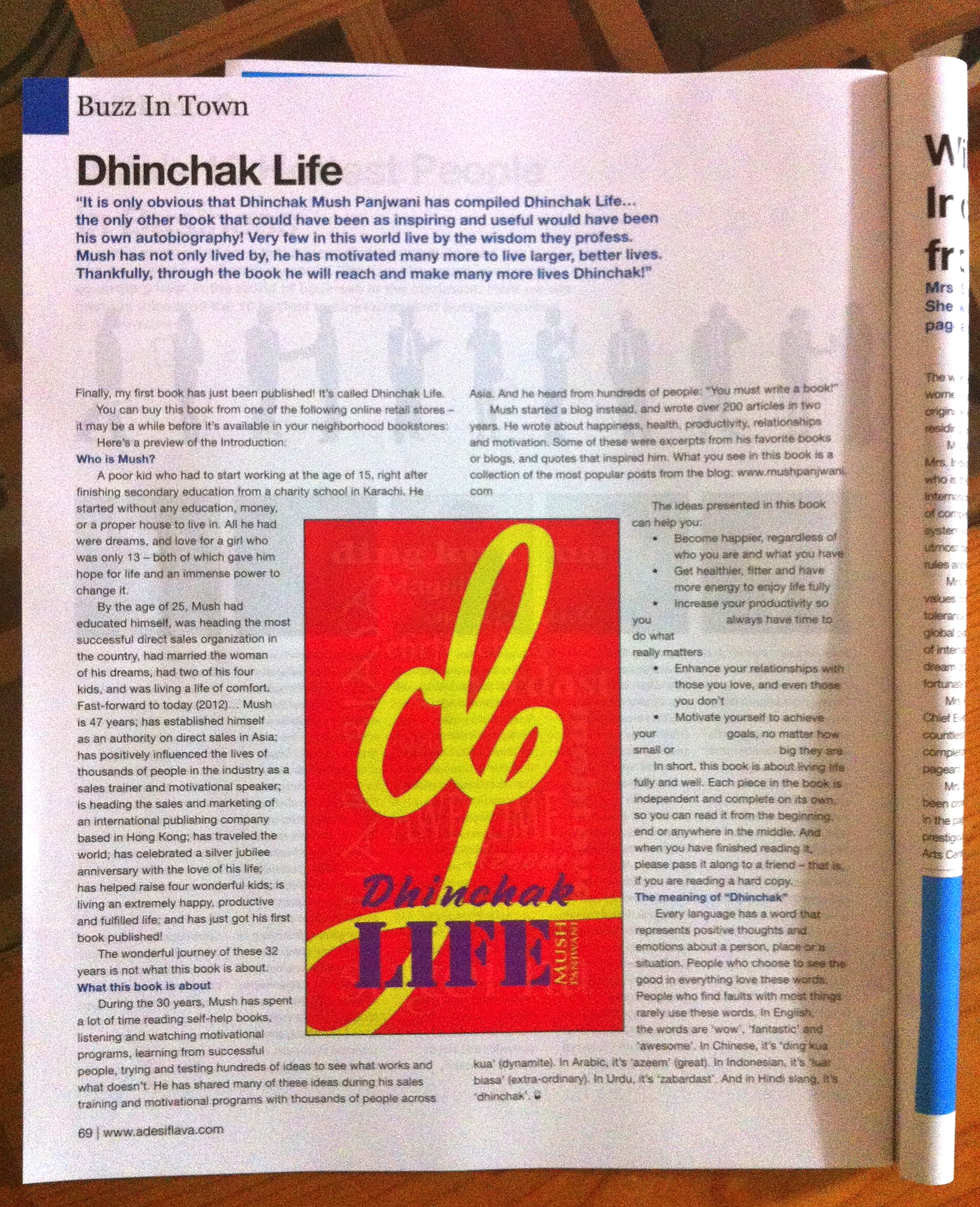 Just saw this in a local magazine in Hong Kong…
If you have read my book, I would love to hear from you. You can:
If you haven’t read it yet, you may order it from:
If you are in Hong Kong, you can also buy it directly from me.
Thanks to all of you for your support and encouragement!

I just read this wonderful article by Shawn Achor at CNN.com. Following are some excerpts. You may read the full article here.
“Scientifically, happiness is a choice. It is a choice about where your single processor brain will devote its finite resources as you process the world. If you scan for the negative first, your brain literally has no resources left over to see the things you are grateful for or the meaning embedded in your work. But if you scan the world for the positive, you start to reap an amazing advantage.
“Now that there is research validity to these claims, the working world is starting to take notice. In January, I wrote the cover story for the Harvard Business Review magazine on “Happiness Leads to Profits.” Based on my article called “Positive Intelligence” and my research in The Happiness Advantage, I outlined our researched conclusion: the single greatest advantage in the modern economy is a happy and engaged workforce.
“A decade of research in the business world proves that happiness raises nearly every business and educational outcome: raising sales by 37%, productivity by 31%, and accuracy on tasks by 19%, as well as a myriad of health and quality-of-life improvements.
“Training your brain to be positive at work is just like training your muscles at the gym. Sounds simple, right? Well, think about how easy it is to make yourself go to the gym. The key with any new resolution is to make it a habit. New research on neuroplasticity – the ability of the brain to change even as an adult – reveals that moderate actions can rewire the brain as you create “life habits.” Continue reading
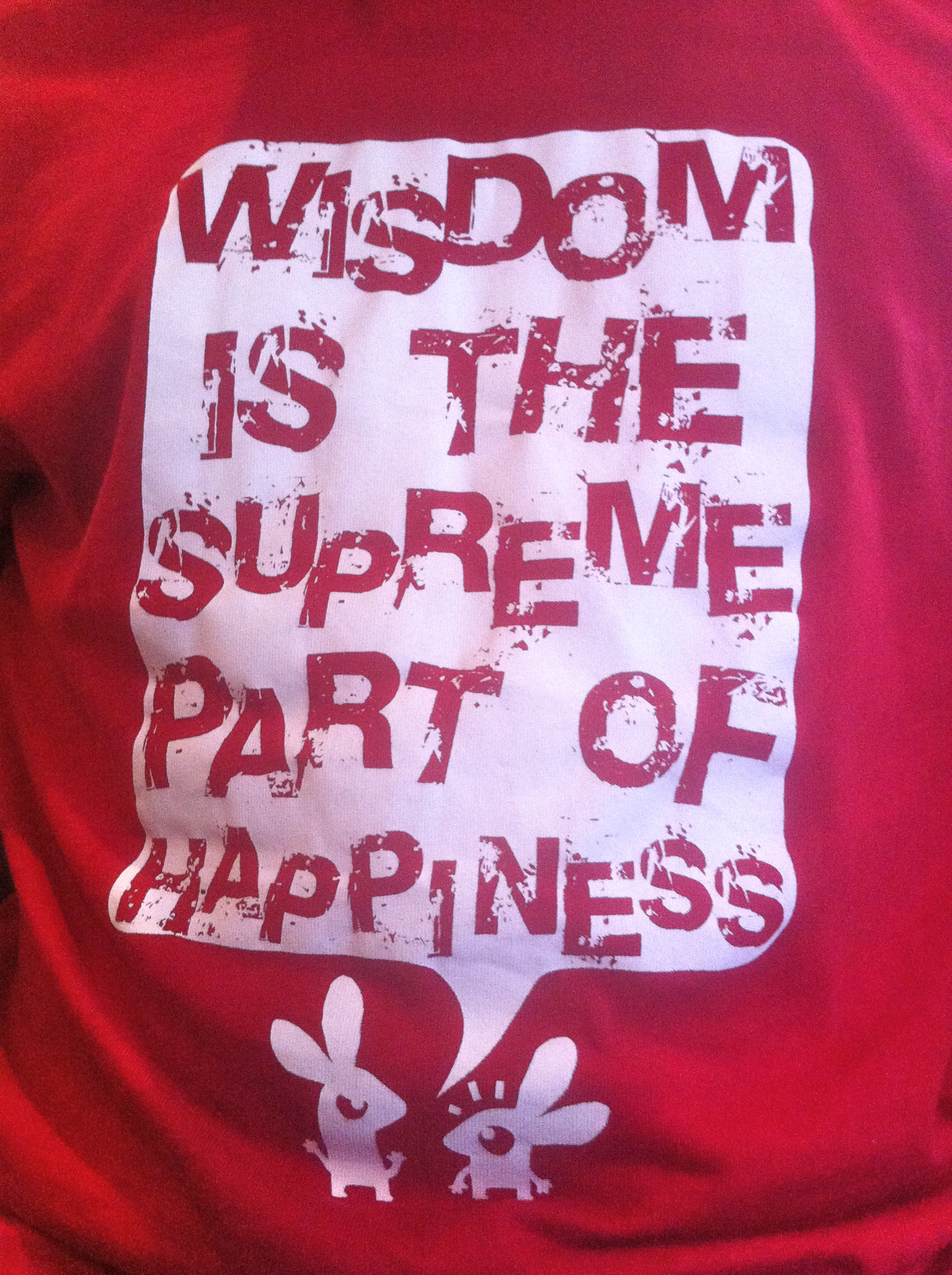 Reblogged from mnmlist.com – one of my favorite blogs about minimalism.
“I believe I’m as happy as it is possible to be.
I’m not crying out in ecstatic pleasure, or streaming tears of joy, but I am very happy. It’s not a peak of happiness, but a plateau of happiness that can go on for as long as I live.
This is a happiness I wish on everyone alive. The question then is, what are the factors that contribute to my happiness?
Here’s what I don’t have:
And I don’t believe having any of those would contribute to greater happiness than I already have. Here’s what I do have that contribute to my happiness:
The first six are seen as the goals of society by many people. The second six make me very happy, and I believe I have them because I decided to forgo the first six. I recommend this path.”

A piece from “Today is Your Best Day” by Roy Lessin:
It’s not your best day because you feel like it is, or because you prevent that it is. It is not your best day because everything is going perfectly, or because you are living in ideal circumstances. It is not your best day because you are in optimum health, or because everything is going you way.
Here are four reasons why today is your best day:
God doesn’t make bad days for your and good days for you. God makes each day fit perfectly into his plans for you.
[Photo of sunrise from one of the McLehose Trails in Hong Kong]
An excellent TED talk by Tali Sharot, neuroscientist and author of The Optimism Bias: A Tour of the Irrationally Positive Brain. She highlights the following with interesting case studies:
“Whatever happens, whether you succeed or you fail, people with high expectations always feel better, because how we feel, depends on how we interpret that event.” Tali Sharot
Another excellent TED talk in which Michael shares a simple way to buy happiness – by giving…
Michael I. Norton is an Associate Professor of Business Administration in the Marketing Unit and Marvin Bower Fellow at the Harvard Business School. He holds a B.A. in Psychology and English from Williams and a Ph.D. in Psychology from Princeton. Prior to joining HBS, Professor Norton was a Fellow at the MIT Media Lab and MIT’s Sloan School of Management. His work has been published in a number of leading academic journals, including Science, the Journal of Personality and Social Psychology, Psychological Science, and the Annual Review of Psychology, and has been covered in media outlets such as the Economist, the Financial Times, the New York Times, the Wall Street Journal, and the Washington Post.
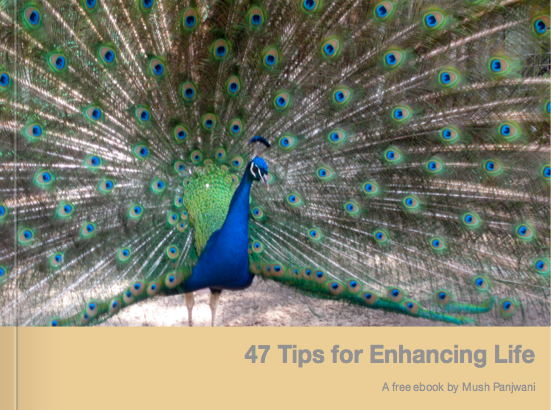
Today (April 12) I turn 47 years old. It amazes me that I’ve been around that long. I feel like I’ve barely begun. As always, it’s an opportunity to reflect on what I’ve achieved, what I’ve learnt, and where do I want to be in five or ten years from now.
Through this photo book, I am sharing 47 tips on happiness, health, relationships and productivity – all of which can enhance life. The photos used in the book are from my personal collection. You can download the book by clicking on the book cover, or from this link. If you find this useful, please share with others too. I will consider that your birthday gift to me.
 I just read these interesting facts on Action for Happiness site:
I was a bit surprised to read about genes contributing up to 50% of our happiness, and have started reading some more about it, but the rest of the facts seem to support most of my views and other posts about happiness. What’s your take on the above?

I recently had the privilege of connecting and interacting with one of the happiest and most successful people I’ve ever known. He started as a salesman and built one of the biggest direct sales companies in the region. I always admired how he found time for leisure and everything else that he enjoyed doing, even during the busiest times of his business. He retired early and rich, while the company runs on the systems he had built. In the following note, he shared with me his thoughts on motivation, productivity and dealing with depression:
Books: Two books that helped me greatly are:
And my favorite now for ageless wisdom is The Portable Thoreau edited Carl Bode.
Work Habits:
By doing these two things I accomplished the same in one third of the time than most people! Now I am stress-free and have lots of leisure. Continue reading
 I’ve lived with this mantra for over five years now, so I was obviously very interested to watch Graham Hill’s talk on TED with that title. He has summarized the benefits very well, but he doesn’t tell us what did he do with all his collections, possessions and stuff. Here’s my story and tips:
When I started the process of reducing my possessions and simplifying my life, I started with the biggest chunk – my collection of books. I realized I wasn’t going to re-read most of them. My hope that my kids would read them all one day wasn’t realistic because they don’t have the same interests as mine. So I gave them all away to friends or charity. I also got rid of the book shelf, so that the books I continue to buy must be given away soon after I finish reading them. Since the iPad, I only buy digital books. They are cheaper, easy to store/backup and environment friendly. You can increase the font size and brightness; you can highlight passages; you can call up a dictionary by just touching the word. And if you really miss the touch and feel and smell of real books, you can visit the book store once a while and get all that for free. I have also tried audio books, and they have their benefits too.
Then I was able to simplify my entire wardrobe to fit into ten hangers and one drawer – plus a small suitcase with winter stuff on one side and special occasion stuff on the other. I took most of the unnecessary clutter out of my life – excessive suits, shoes, belts, ties, watches (I’ve actually stopped wearing a watch), videos, CDs etc. I still need to finish scanning the photos and get rid of the albums. All of this means, I need less space for my possessions and less maintenance time. I can focus on quality instead of quantity/variety. I only buy things that I really need and have space for. If I buy a new shirt, an old shirt has to go.
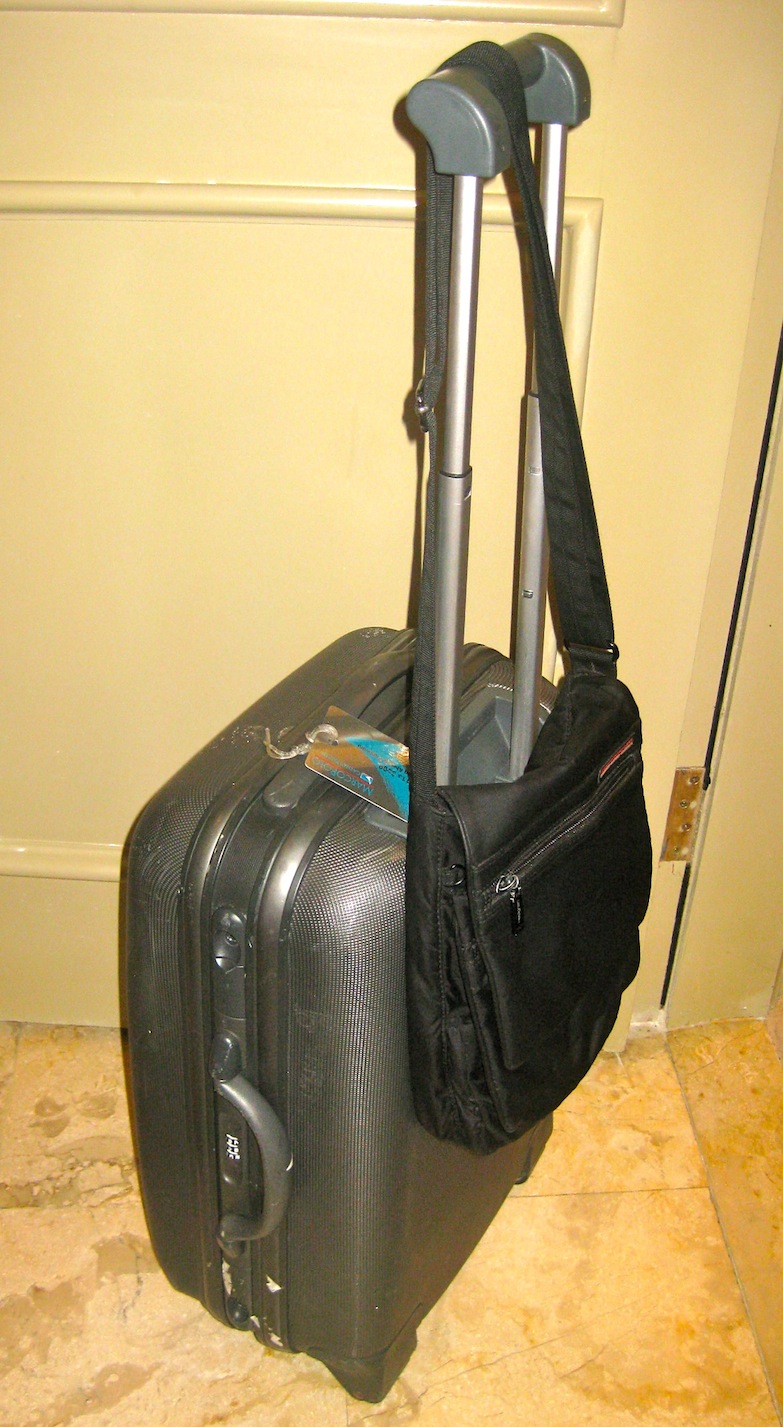
My travel bag has got smaller and smaller, regardless of the length of the trip, and is now down to a small carry-on, without the additional backpack that used to go with it. I still take all the photos and make all the movies with my pocket Canon Ixus. That means I can pack easily and quickly, travel much lighter and move around easily. I have applied the same principle to my work i.e. office space and desk. It’s all easier said than done, but extremely rewarding and worthwhile. I believe it makes you more productive, more efficient, lighter and happier!
[Photo of my travel bags taken just now in the hotel room. The shoulder bag has the camera, spare battery, spare SD cards, phone, wallet, passport, charger, pens and few other essentials]
 Mush Panjwani